

UK consumer confidence falls as households worry about debt
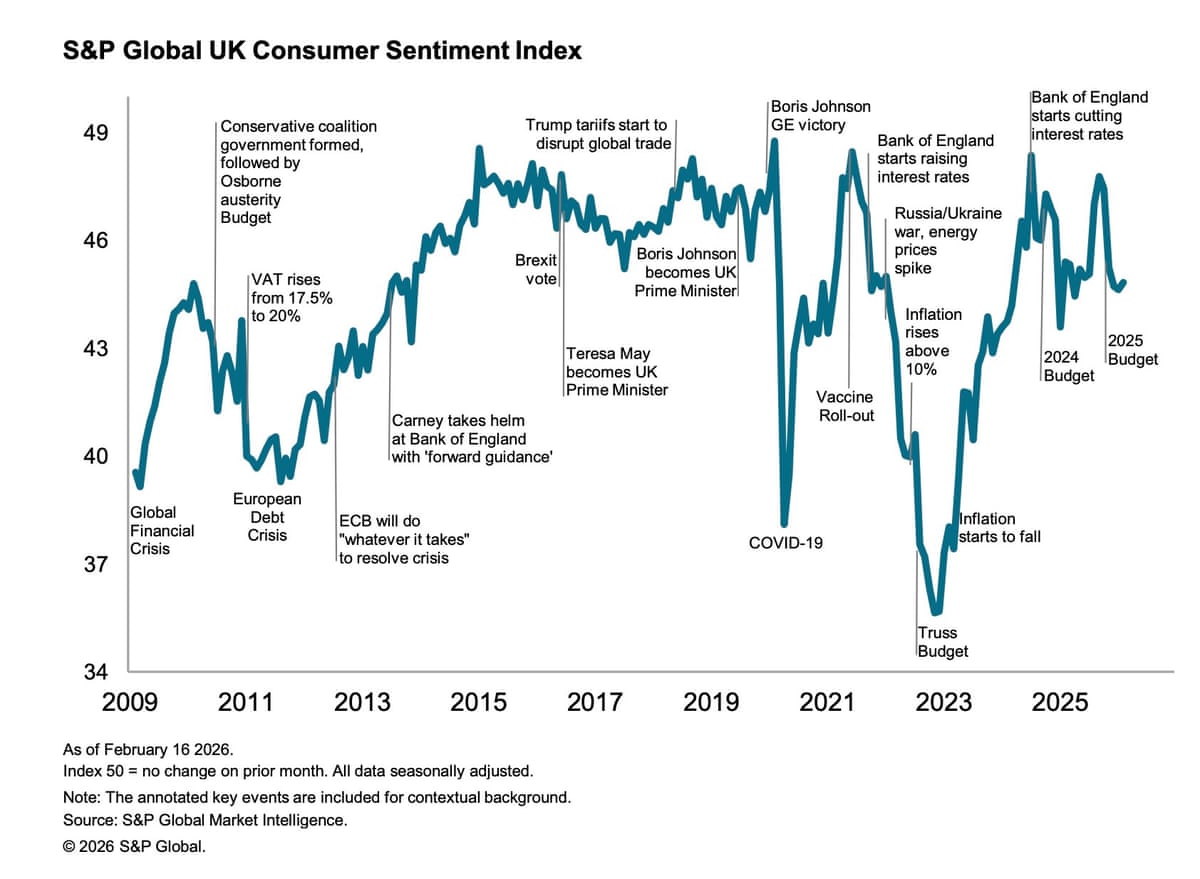
UK consumer sentiment continued to decline in February as households expressed growing concerns about debt levels. A consumer confidence poll by data firm S&P Global indicated that morale dropped further this month, although the rate of decline was slower than in January.
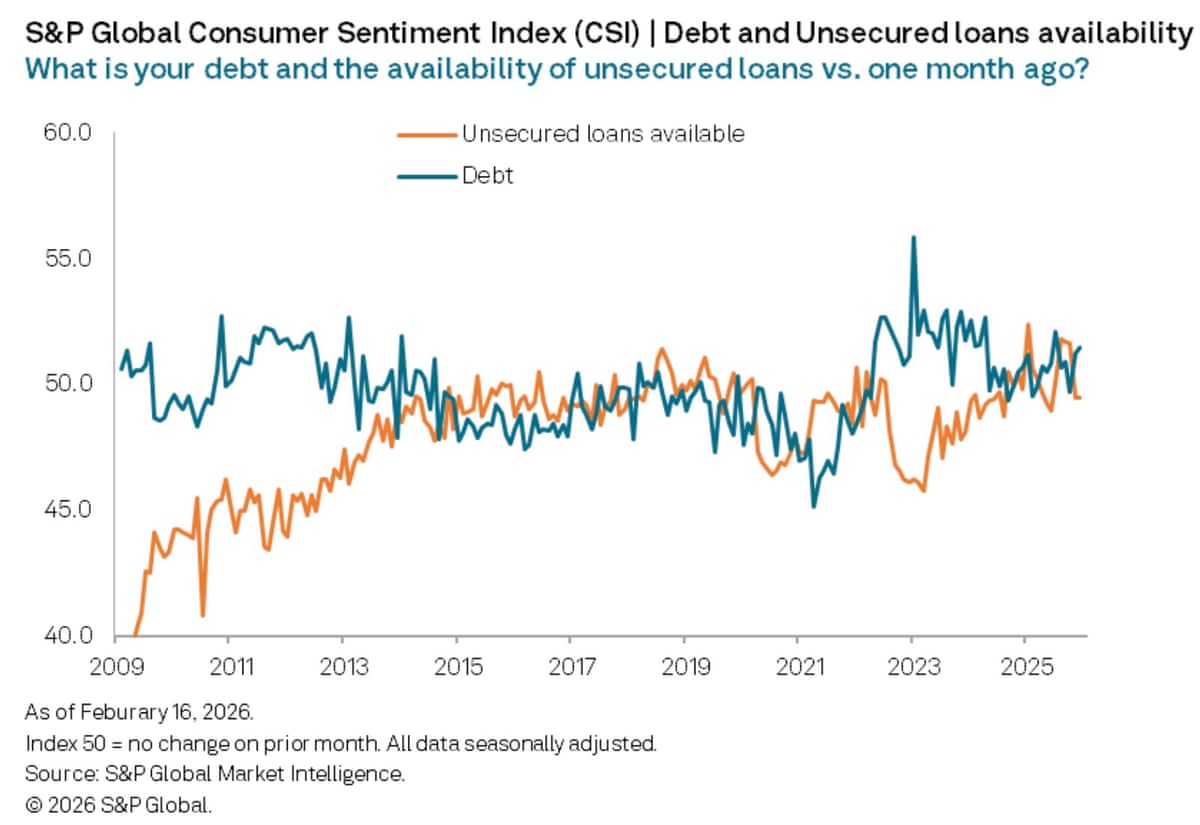
Consumers reported a stronger increase in debt alongside a faster deterioration in loan availability. Appetite for major spending fell to its weakest level in ten months, while sentiment regarding labour market conditions reached its lowest point since June of the previous year.
This resulted in the S&P Global UK Consumer Sentiment Index (CSI) registering 44.8 in February, a slight increase from 44.6 in January but still below the 50-point threshold that indicates no change compared with the prior month.
“The mood among UK households matches the dismal weather seen so far this year across the country. Although the overall degree of gloom has lifted slightly since January, consumer confidence continues to run at one of the lowest levels seen over the past two years.
A period of prolonged rain and a dearth of sunshine have no doubt not helped to lift the low spirits seen among households, but there’s more going on here than just bad weather. Households are growing increasingly worried about debt in particular, especially as a rising need for credit was met with the steepest decline in availability of loans since August 2024.
Households’ appetite for major purchases was impacted by the lack of confidence and debt worries, with sentiment around big ticket expenditure slipping to the lowest in ten months. The low appetite to spend bodes ill for the broader impetus to purchase, hinting at a sustained drag on economic growth from sluggish consumer spending in the first quarter.”
A majority of City economists expect the Bank of England to cut interest rates at its next meeting. polled 63 economists over the past week, finding that 41 predict the BoE will reduce the Bank Rate by 25 basis points to 3.50% on March 19.
Israel's growth picked up in 2025
Israel’s economic growth accelerated in 2025, marking the first increase since the onset of the war in Gaza. Official data released on Monday showed the economy expanded by 3.1% last year, rebounding from a slowdown to just 1% growth in 2024.
The growth was driven by a 7.1% rise in investment and a 5.9% increase in exports, alongside a modest rise in consumer spending. Heavy government expenditure during the two-year Gaza conflict, particularly on defence, also provided an economic boost, according to .
Israel’s economy grew at an annualised rate of 4.0% in the fourth quarter of 2025, supported by a 33% jump in exports. The economy had grown by 2.1% in 2023 and 1% in 2024. Growth is expected to continue into 2026.
The indications for the first quarter of 2026 are also positive - you see that in the trade balance data, etc. So I think it ... sets the basis for continued recovery.”
— Yonie Fanning, chief strategist at Mizrahi Tefahot Bank
Storms disrupt UK postal deliveries
Recent storms have also caused disruptions to UK postal services. Royal Mail attributed missed delivery rounds and delayed letters to stormy weather and high levels of staff sickness. According to the BBC, which cited reports from over a dozen Royal Mail postal workers across different delivery offices, daily missed rounds and letters left undelivered for weeks have been reported.
Royal Mail stated that “short-term disruption to certain routes” was caused by “adverse weather, including storms Goretti, Ingrid and Chandra in January, alongside higher than usual sick absence.”
UK regulator fines Carillion's former CEO £237,700
The Financial Conduct Authority (FCA) has fined Richard Howson, the former chief executive of construction firm Carillion, £237,700 for his role in issuing misleading statements prior to the company’s collapse. The FCA found that Howson failed to disclose Carillion’s severe financial difficulties in company announcements and did not alert the board or audit committee.
The FCA determined that Howson acted recklessly and was knowingly involved in breaches of the Market Abuse Regulation and Listing Rules by Carillion.
‘Carillion’s failure was significant. Jobs were lost, public sector projects put at risk and investors, who trusted the company to give them accurate information, suffered large scale losses. That’s why the FCA worked diligently to hold the company and its senior leaders to account.’
— Steve Smart, executive director of enforcement and market oversight at the FCA
Last month, the FCA fined two former Carillion finance directors, Richard Adam and Zafar Khan, for misleading investors before Carillion entered liquidation with £7bn of debts in January 2018, resulting in widespread financial losses.
Bad weather hits fruit production, but boosts Morocco's wheat output
Recent wet weather across Europe and northern Africa has adversely affected fruit production but has benefited wheat farmers. In Morocco, grain traders anticipate the cereals harvest to double this season following abundant winter rains.

Omar Yacoubi, head of Morocco’s wheat trading federation FNCL, told :
“We expect a good cereals harvest this year of 8 to 9 million tons, including around 5 million tons of soft wheat.”
The previous harvest yielded 4.4 million tons, including 2.4 million tons of soft wheat.
However, heavy rains and flooding have severely damaged fruit farms in Morocco and Spain. Journalist Harry Wallop highlighted on X the impact on berry supplies:
🍓🫐 Noticed a shortage of raspberries, strawberries & blueberries on the supermarket shelf? You could soon. 🇪🇸 🇲🇦 Devastating storms in Spain & Morocco – where we get most of our winter berries – have destroyed polytunnels, flooded farms. 150,000 have been evacuated in 🇲🇦 🧵1/3 pic.twitter.com/6ZFpyh78Vg
🇲🇦 Begnat Robichaud, at iBerry, which supplies most UK supermarkets from Morocco: "It's an absolute disaster for the area and for our industry. We can't even access our packhouse because the village in which it is in is so badly flooded." 🧵2/3 pic.twitter.com/9o8UWVupmO
Food supply company Fresh Direct has warned that availability of multiple products will be affected for “some time due to delayed plantings and weather-related quality issues.”
Ongoing poor weather across several key European growing regions continues to disrupt harvests and transport logistics. This affects product quality, availability, and ferry routes are struggling to recover from delays.

UK's FRC may allow Chinese auditors to use home standards for London listings
The Financial Reporting Council (FRC), Britain’s auditors regulator, is considering permitting Chinese auditing firms to apply Chinese Standards on Auditing (CSAs) for companies listing in London. This initiative is part of the UK government’s efforts to stimulate economic growth and enhance the competitiveness of London’s financial markets.
The FRC is consulting on an amendment to its Third Country Auditor (TCA) policy to temporarily allow auditors of Chinese-registered entities listing Global Depositary Receipts (GDRs) in London to use CSAs for UK listing purposes.
GDRs represent shares in a foreign company traded on a local stock exchange, enabling investors to access the stock without a full primary market listing.
Eurozone industrial output dropped in December
The eurozone’s manufacturing sector experienced its largest monthly decline in activity since April 2025, with industrial production falling 1.4% month-on-month in December, according to Eurostat. The decline was primarily driven by a drop in capital goods, which include physical assets such as tools and machinery.
Breakdown of industrial production changes included:
- Intermediate goods decreased by 0.1%
- Capital goods decreased by 1.9%
- Durable consumer goods increased by 0.2%
- Non-durable consumer goods decreased by 0.3%
UK households pessimistic about finances and spending
UK households across all 12 regions and nations reported reductions in both cash availability and savings. The steepest falls in cash availability were observed in the East Midlands and Northern Ireland, with the East Midlands also recording the fastest decline in savings, closely followed by Yorkshire & Humber.
Consumer sentiment regarding debt reached its lowest level in 23 months. The latest report shows that UK households indicated a further increase in debt in February, with the rate of accumulation the strongest since July of the previous year.
Debt levels rose across all age groups except those aged 25–34, where debt stabilized. The steepest increase was among 18–24 year olds. Households also expressed a stronger need for unsecured credit, but loan accessibility continued to deteriorate, with the availability of unsecured credit declining at the steepest pace in 18 months.
S&P Global also reported that households across all UK regions experienced a decline in current financial health this month. The East Midlands recorded the steepest reduction, while London saw the smallest decline.
The consumer sentiment report noted:
Although sentiment around current finances was less downbeat, households were slightly more pessimistic regarding their financial prospects for the coming next 12 months.
The seasonally adjusted index dipped to a two-month low, with only households in London, the West Midlands, and the North West forecasting an improvement in their financial health over the next year.


