The Battle for Warner Bros Discovery
The competition in Hollywood to acquire Warner Bros Discovery is intensifying into a major corporate showdown.
Paramount Skydance, supported by the billionaire Ellison family, has been courting Warner Bros for several months, aiming to merge with the historic media company as it faces challenges competing with giants like Netflix and Disney.
Despite Paramount's efforts, Warner Bros has rejected its offers and instead announced an agreement to sell its most valuable assets—its studio and streaming divisions—to Netflix.
In response, Paramount CEO David Ellison initiated a hostile takeover bid, appealing directly to Warner Bros shareholders.
What is a Hostile Takeover Bid?
In corporate acquisitions, a hostile takeover occurs when one company attempts to purchase another without the approval of the target company's management, typically by making a direct offer to the shareholders.
This contrasts with a friendly takeover, which involves mutual agreement between the boards and shareholders of both companies.
Paramount's hostile bid was reportedly triggered by Netflix's perceived lack of responsiveness to Ellison's recent proposals, according to an official company filing cited by media outlets.
Details of the Competing Bids
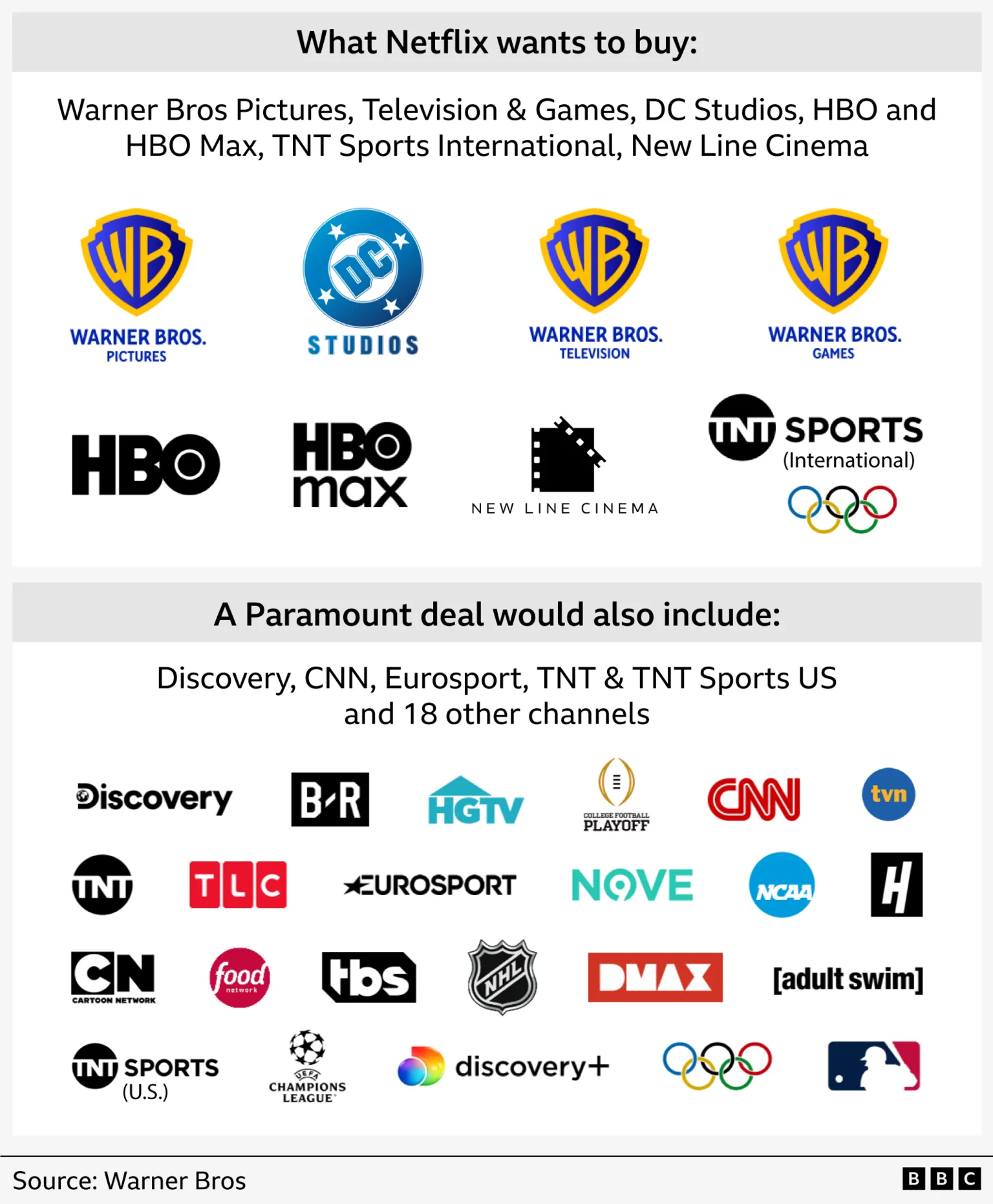
Netflix's offer focuses on acquiring Warner Bros' studio and streaming networks, with the remainder of the company planned to be spun off as an independent entity.
The proposal values these assets, which include Warner Bros, New Line Cinema, and HBO Max, at $82.7 billion including debt.
Netflix is offering $27.75 per share in cash, enhancing its initial bid that combined cash and shares in the new company.
Paramount, in contrast, seeks control of the entire Warner Bros company, including its traditional pay-TV networks, which are considered a declining sector.
Paramount's bid values the entire company at $108.4 billion.
It proposes an all-cash offer of $30 per share, which it argues provides shareholders with greater certainty compared to Netflix's mixed offer.
Paramount has also included incentives such as agreeing to cover the $2.8 billion breakup fee Warner Bros has committed to pay Netflix if that deal fails.
Both transactions have target completion dates set several months in the future.
Why Are Paramount and Netflix Interested in Warner Bros?
Warner Bros, with a history spanning nearly a century, possesses an extensive content library including classics like Looney Tunes and Casablanca, as well as popular franchises such as Friends, Superman, and Harry Potter.
Its HBO division is renowned for critically acclaimed television series including The Sopranos, Sex and the City, and Succession.
However, Warner Bros has been under pressure due to the disruption caused by online streaming in the film and television industries.
For Netflix, the leading streaming service with over 300 million rs, acquiring Warner Bros' film and streaming assets would enhance its movie offerings and prevent competitors from obtaining Warner Bros content.
Paramount aims to partner with Warner Bros to gain the scale necessary to compete with industry leaders like Netflix and Disney.
This acquisition would build upon David Ellison's recent purchase of Paramount, which he integrated into his Skydance film studio over the summer.

On the streaming front, Paramount seeks to combine HBO Max's approximately 120 million rs with its own 79 million.
Analysts suggest the merger could also benefit traditional pay-TV networks by increasing their negotiating power and enabling cost efficiencies.
Paramount's traditional networks include Nickelodeon, CBS, and Comedy Central, while Warner Bros would add CNN, Food Network, and various sports properties.
Who Is Favored to Win the Bid?
Both offers face potential regulatory scrutiny in the United States and Europe due to competition concerns.
Netflix's plan has raised warnings that it would further consolidate power in streaming, potentially affecting actors, screenwriters, and local cinemas.
A combined Paramount-Warner Bros entity would control a significant portion of sports and children's entertainment, raising concerns among advertisers and local broadcasters.
Paramount's proposal, which would place CBS and CNN under one parent company, has attracted attention due to implications for the news industry and the Ellison family's connections to former President Donald Trump.
Analysts indicate that regulatory approval may depend on how broadly competition markets are defined and whether platforms like YouTube are considered competitors.
Some observers believe Paramount may have an advantage due to the Ellison family's relationship with Trump, including tech billionaire and Republican donor Larry Ellison.
Trump, a frequent critic of CNN, has advocated for the network's sale as part of any deal, a condition met by Paramount's bid.
However, the former president has not clearly endorsed either company.
Although he has previously praised the Ellisons, on social media in early June, Trump criticized their ownership of Paramount following a 60 Minutes interview aired by the company featuring former ally-turned-critic Marjorie Taylor Greene, a Republican congresswoman.
Earlier, Trump expressed concerns about Netflix's size but also complimented its leadership.
In February, Trump stated he would defer the decision to the Department of Justice rather than personally intervening as he had initially suggested.
Potential Impact on Consumers
Neither Netflix nor Paramount has provided detailed plans on how they would integrate Warner Bros into their current services or develop new streaming packages.
Regarding pricing, expanding Netflix's offerings could justify higher subscription fees, but consumers might save money if they to one combined service instead of multiple platforms.
Analysts at Raymond James report that over 70% of HBO Max rs in the United States also to Netflix.
Jared Kushner's Role in the Paramount Bid
Paramount's initial offer included financing from Affinity Partners, an investment firm founded by Jared Kushner, President Trump's son-in-law, in 2021.
Kushner's net worth is estimated by Forbes at over $1 billion (£750 million).
Investors from the Saudi and Qatari sovereign wealth funds backing Paramount had agreed not to assume controlling roles, such as board seats, in exchange for their investments.
Following scrutiny over the Trump family connections, Kushner announced that his firm would no longer participate in the deal.
Additional reporting by Danielle Kaye and Pritti Mistry