

Asia-Pacific Markets Impacted by Iran Ultimatum
Global stock markets are experiencing significant declines following US President Donald Trump’s ultimatum threatening to 'obliterate' Iran’s power plants unless the Strait of Hormuz is reopened. This announcement has triggered widespread selling across Asia-Pacific markets at the start of the week. Japan’s Nikkei index fell 3.4% in afternoon trading, China’s CSI 300 declined 2.8%, and South Korea’s KOSPI index dropped sharply by 6.5%.
Analysts warn that the conflict is entering a new phase of escalation after Tehran responded by threatening to “irreversibly destroy” critical infrastructure across the Middle East. Investor strategist Neil Wilson of Saxo UK noted that markets are beginning to recognize the severe potential long-term impacts on energy markets.
“This is an escalatory doom loop – or ‘escalation trap’ with currently no realistic off-ramp. Neither side has an incentive to back down as the costs of doing so are increasing day by day. Each side thinks pushing harder will force the other to back down.”
In addition to concerns over conflict escalation, investors are also preparing for potential interest rate hikes this year as central banks face pressure to combat rising inflation.
Two Indian LPG Carriers Transit Strait of Hormuz
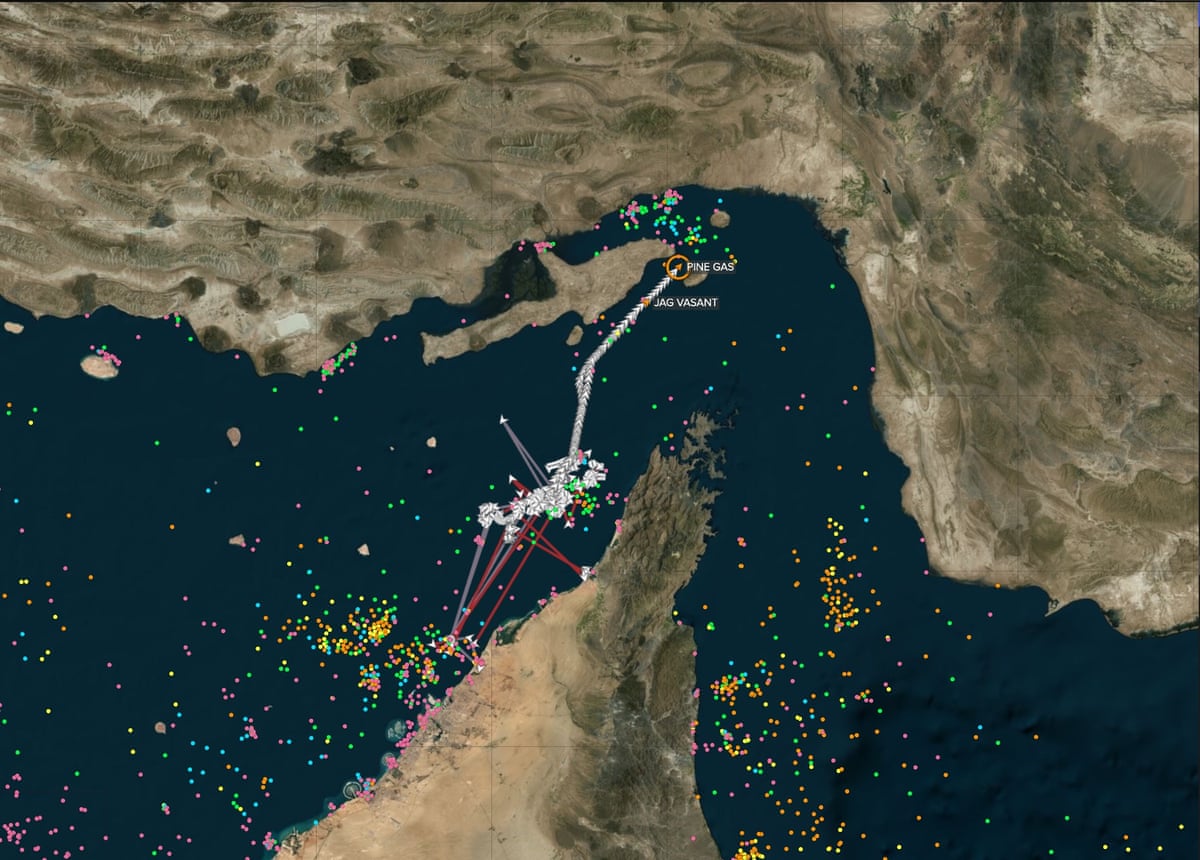
According to Bloomberg, two Indian-flagged liquefied petroleum gas (LPG) carriers are currently transiting the Strait of Hormuz, navigating close to the Iranian coastline.
Ship-tracking data indicates that the vessels, Jag Vasant and Pine Gas, both very large gas carriers flagged to India, traveled northwards from the UAE coast towards Iran’s Qeshm and Larak islands early Monday.
While the ships signaled Indian ownership without specifying a destination, they are likely en route to India, which is experiencing acute LPG shortages used primarily as cooking gas. These vessels follow two other Indian-flagged LPG carriers that transited the strait earlier this month.
Gas Prices Rise Amid Conflict
Wholesale gas prices in Europe have increased during early trading sessions. UK month-ahead gas prices rose 3.1% to 155 pence per therm, nearly double their levels before the conflict began. However, this remains below last week’s peak of 180 pence, which followed Israel’s attack on the Iranian South Pars gas field.
The Dutch front-month gas contract increased 3.7% to €61.45 per megawatt hour. Meanwhile, US crude oil futures climbed over $3 to $101.26 per barrel.
European stock markets are expected to open lower within the next half hour. The futures contract for the UK’s FTSE 100 index declined over 1% this morning. The index fell below 10,000 points last Friday, erasing all gains made in 2026.
Amid rising tensions, the chief executive of Saudi Aramco, the world’s largest energy company, reportedly withdrew from a major energy conference in Houston due to concerns over escalating Middle East conflict.
Oil prices remain relatively stable this morning. Brent crude is up 1.2% at $113.34 per barrel, well below the near-record highs of almost $120 per barrel seen earlier this month.
Senior analyst Ipek Ozkardeskaya commented:
“Oil prices are higher this morning as risks build that regional energy infrastructure could suffer further damage, potentially triggering a larger and more prolonged energy shock.”
Fatih Birol, executive director of the International Energy Agency (IEA), warned last week that this conflict could represent the “greatest threat to global energy in history,” underscoring the urgency to accelerate alternative energy development.
IEA Chief Compares Iran War Energy Crisis to 1970s Oil Shocks and Ukraine Fallout
The global energy crisis resulting from the Iran conflict is comparable to the combined impact of the twin oil shocks of the 1970s and the consequences of Russia’s invasion of Ukraine, according to Fatih Birol, head of the International Energy Agency.

Speaking at the National Press Club of Australia in Canberra on Monday, Birol highlighted that the growing repercussions could be significantly worsened by disruptions to critical components of the global economy, including petrochemicals, fertilizers, sulfur, and helium.
He noted that the severity of energy market disruptions caused by American and Israeli bombings in Iran, coupled with the closure of the strategic Strait of Hormuz, had not been fully appreciated by world leaders initially.
US Dollar Strengthens as Safe Haven
The US dollar is strengthening amid escalating retaliatory threats in the Middle East, as investors seek safe-haven assets. The dollar index, which measures the greenback against a basket of currencies, increased by 0.2%, while the British pound declined by half a cent to $1.329.
Gold Prices Decline Sharply
Spot gold prices have fallen rapidly today, dropping 4.6% to $4,280 an ounce, reaching a nearly four-month low. Traders attribute the decline to rising expectations of higher global interest rates.
Tim Waterer, chief market analyst at KCM Trade, explained:
“With the Iranian conflict into its fourth week, and oil prices hanging around the $100 level, expectations have pivoted from rate cuts to potential rate hikes, which have tarnished gold’s appeal from a yield point of view.”
UK Economy Growth Forecast Slashed Amid Energy Price Shock
Good morning, and welcome to our continuous coverage of business, financial markets, and the global economy.
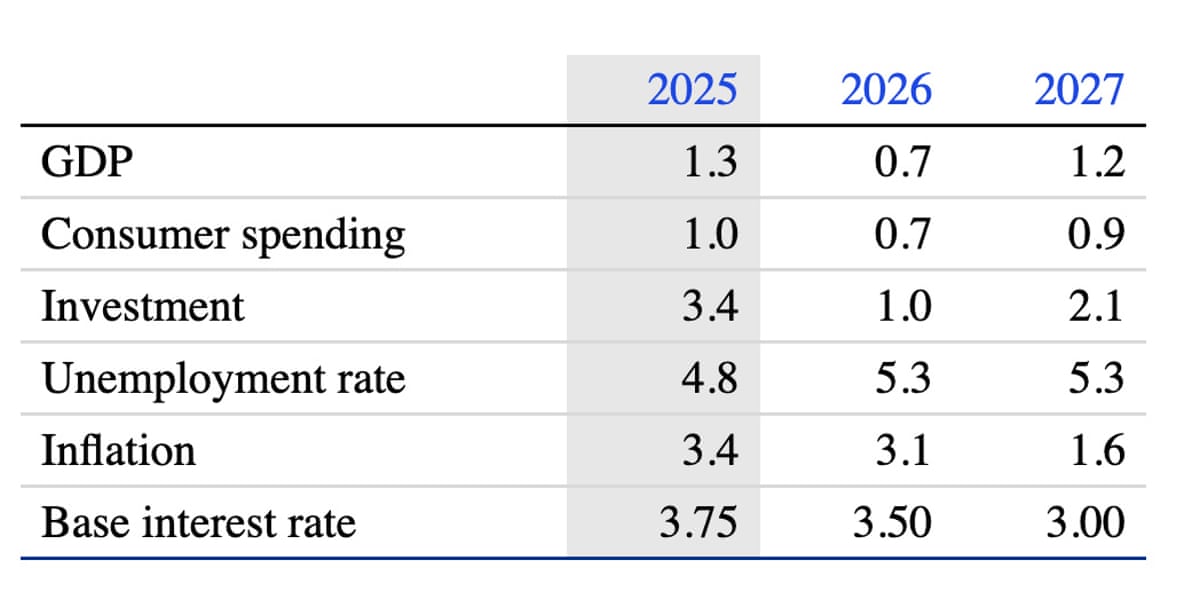
Growth across the UK economy is projected to nearly halve in 2026 as the ongoing conflict in the Middle East drives energy prices higher.
New forecasts from KPMG released this morning indicate that UK GDP is expected to grow by only 0.7% in 2026, down from 1.5% in 2025. This represents a downward revision from December’s forecast, which predicted a 1% growth rate for this year.
The energy price shock reverberating through the UK economy is anticipated to increase inflation, suppress consumer spending, and delay interest rate reductions.
KPMG also forecasts a slowdown in investment and an increase in the unemployment rate to 5.3% this year and next, up from 4.8% in 2025.
Yael Selfin, chief economist at KPMG UK, stated:
“The outlook for growth in 2026 has taken a hit from the impact of higher energy prices, a cooling labour market and weak household spending.
“The weaker growth outlook coupled with growing cost pressures will likely see firms scale back any investment plans over the coming year. Consumers could also cut back on discretionary spending to offset the squeeze from higher prices.
“With inflation likely to re-accelerate from this summer, the Bank of England will be reluctant to move quickly on rates, meaning households and businesses will face higher borrowing costs for longer, even as the economy slows.”
Amid growing concerns of a new cost of living crisis, Andrew Bailey, Governor of the Bank of England, is scheduled to meet with Labour leader Keir Starmer and senior government ministers later today.
The Trades Union Congress (TUC) is calling for the establishment of an emergency taskforce comprising employers, unions, and the government to mitigate the UK’s economic fallout from the US-Iran conflict.
Upcoming Economic Events
12:30pm GMT: Chicago Fed National Activity Index for February
3:00pm GMT: EU Consumer Confidence Flash for March


