

Introduction: Japan's Nikkei Hits Record High and Yen Strengthens After Takaichi's Election Win
Good morning, and welcome to our continuous coverage of business, financial markets, and the global economy.
Political developments are at the forefront for investors today, as they respond to a landmark election in Tokyo alongside increasing pressure on UK Prime Minister Keir Starmer.
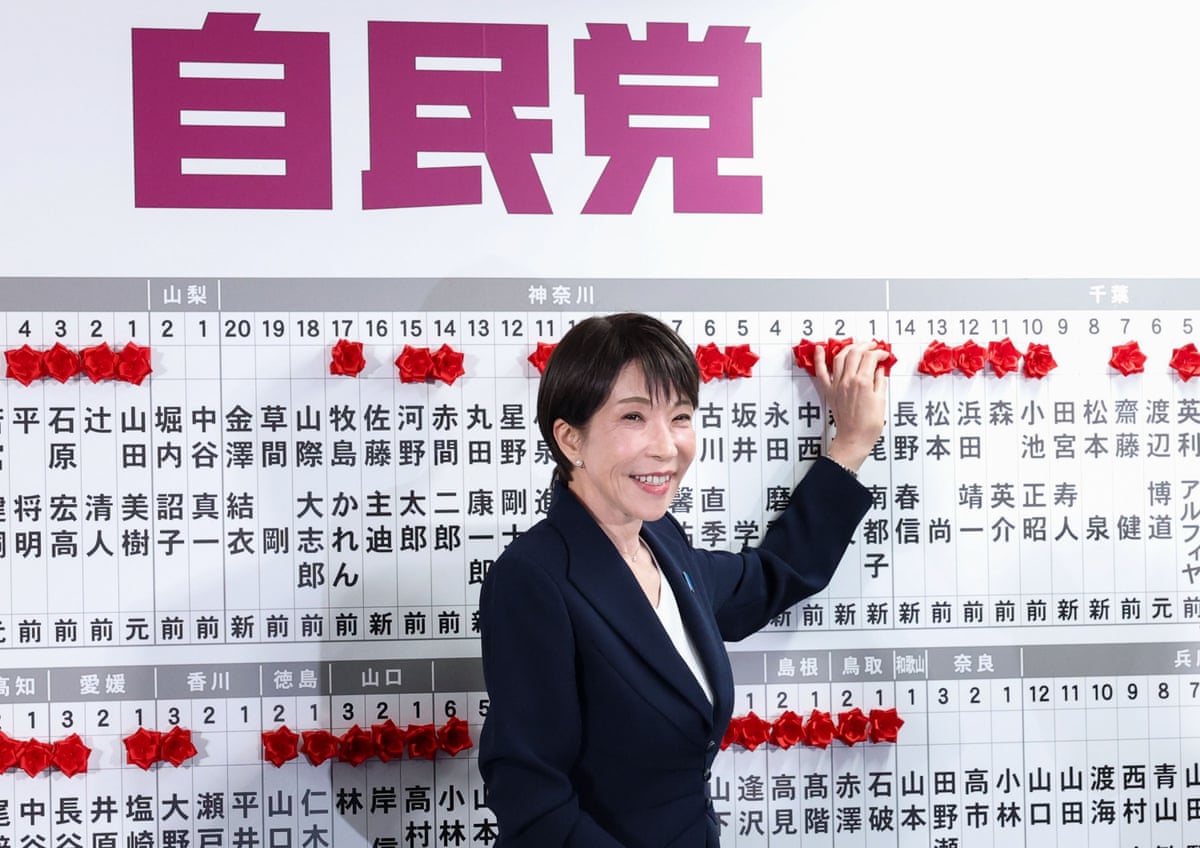
The yen has strengthened following Japanese Prime Minister Sanae Takaichi’s decisive victory in Sunday’s election, ending a six-day period of losses.
The Japanese stock market has surged to a new peak as investors anticipate further stimulus measures.
Takaichi’s Liberal Democratic Party (LDP) secured an absolute majority in Japan’s lower house, and together with its coalition partner, the Japan Innovation Party, holds a supermajority of two-thirds of the seats.
This majority will facilitate Takaichi’s plans to implement a 21 trillion yen (£99 billion) stimulus package and her commitment to suspend Japan’s 8% sales tax on food for two years.
These proposals had unsettled financial markets and caused currency volatility during the election campaign, but there is now relief that political uncertainty in Japan appears to have been resolved.
ING commented that the LDP’s landslide victory is positive for risk assets, despite concerns that her policies could increase Japan’s borrowing levels:
"Prime Minister Takaichi’s decision to leverage her popularity for her party turned out to be successful. The landslide victory will reinforce her responsible but expansionary fiscal spending and a more Japan-focused foreign policy. Risk-on sentiment will dominate the market for now."
Japan’s Nikkei share average surged to a record high on Monday following the election results, surpassing the 56,000 level for the first time at the start of trading. It quickly exceeded the 57,000 point mark before closing up 3.9% at 56,363 points.
Stock markets generally favor additional fiscal stimulus. After Sanae Takaichi secured Japan’s largest postwar election victory, the Nikkei 225 surged over 5% at Monday’s open. Equities had already outperformed in the four months since she took leadership of the LDP, even accounting for the weak yen.
Nikkei was up significantly following Takaichi's overwhelming election win, reaching +4.4% as of 12:35pm local time.
The Agenda
Noon BST: European Central Bank chief economist Philip Lane delivers a lecture at Maynooth University.
4pm BST: ECB President Christine Lagarde participates in a plenary debate on the state of the EU economy and ECB activities in Strasbourg, France.
Returning to Japan, Neil Newman, managing director and head of strategy at Astris Advisory Japan, summarized the significance of Sanae Takaichi’s achievement in winning an absolute majority in Tokyo’s lower house:
"Overall, as the LDP has gone from a very weak government that really couldn’t do anything to an extremely strong government now with the supermajority of the lower house, they really could call the shots."
Greggs' Shares Fall Amid Concerns Weight-Loss Drugs Could Impact Spending
UK bakery chain Greggs is facing pressure as analysts warn that the surge in weight-loss products might reduce demand for its pasties, pies, and sausage rolls.
Stockbroker Jefferies suggested last weekend that drugs such as Mounjaro and Wegovy may present an "enduring challenge" for Greggs and impede its growth.
Greggs is the top decliner on the FTSE 250 index of medium-sized companies, down 4.2% this morning to 16.09p, a decrease of 72p.
Victoria Scholar, head of investment at Interactive Investor, commented:
"Greggs is suffering today, falling sharply after Jefferies cut the stock from a buy to a hold. The broker said that weight loss drugs like Mounjaro could create an ‘enduring challenge’ for the company."
InPost Shares Surge After FedEx-Led Consortium Takeover
Shares in parcel locker group InPost jumped 13.5% after a consortium led by FedEx Corporation and private equity firm Advent agreed to acquire the company for €7.8 billion (£6.8 billion).
The bidders offered €15.60 per share for Polish-headquartered InPost and plan to expand further across the UK and Europe.
In the UK, the group aims to more than double locker points to 30,000 from the current 14,000, while maintaining 5,500 pick-up and drop-off points.
InPost’s shares quickly rose above the €15 mark.
European stock markets also started the new week positively.
The pan-European Stoxx 600 index gained 0.27%, as last week’s concerns over AI’s impact on software and data companies appeared to subside.
Yen Outlook Post-Election
Japan’s election result is expected to encourage further selling of the yen, according to Lee Hardman, currency expert at MUFG Bank.
Hardman told clients this morning:
"Yen weakness following the election result has been constrained by the heightened risk of intervention as USD/JPY moves back into the high 150.00s. Japan’s top currency official Atsushi Mimura warned that they are watching market moves with a high sense of urgency."
This followed comments from Finance Minister Satsuki Katayama, who stated after the election victory that she would communicate with financial markets on Monday if necessary. She reiterated:
"Japan and the US have signed a memorandum of understanding, which stated that we can take decisive measures against rapid movements out of line with fundamentals. That certainly includes intervention."
The ongoing threat of intervention has helped dampen further yen selling after the lower house election, although the currency remains vulnerable if market participants remain concerned about policy direction under Prime Minister Takaichi.
NatWest Shares Decline After Evelyn Partners Acquisition
Shares in banking group NatWest dropped over 5% after it agreed to acquire Evelyn Partners, one of the UK’s largest wealth managers.
NatWest will pay £2.7 billion for Evelyn Partners, a move that will strengthen its wealth management division.
Evelyn Partners, formerly known as Tilney Smith & Williamson, manages approximately £69 billion in client assets and offers financial planning and wealth management services across the UK and Ireland.

The company’s origins date back to 1836 when Thomas Tilney established his stock brokerage in London. Tilney was acquired by Permira in 2014, before purchasing the 145-year-old Glasgow-based investment firm Smith & Williamson in 2019 and rebranding three years later.
Pound Drops to Two-Week Low Amid Political Pressure on Starmer
Sterling declined this morning following the resignation of Morgan McSweeney, Keir Starmer’s chief of staff, which increased pressure on the prime minister.
The pound fell by half a euro cent to €1.146, its lowest level since 22 January.
It also edged down by 0.12% against the US dollar, reversing a small portion of Friday’s rally.
UK bond yields rose slightly, mirroring moves in US Treasuries.
The yield on 10-year UK government bonds increased by two basis points to 4.539%, a modest rise that slightly raises Britain’s borrowing costs.
Mohit Kumar, economist at Jefferies, stated:
"In the UK, political pressure on PM Starmer is mounting which is weighing on UK assets."
Analysts Highlight Takaichi’s Historic Election Success
Analysts at UniCredit noted that Sanae Takaichi achieved Japan’s best-ever post-war election result.
The parliamentary election held yesterday resulted in an overwhelming victory for the Liberal Democratic Party, led by Takaichi, which secured two-thirds of the seats in the lower house—the best result for a single party since World War II.
Japanese stocks performed well as Takaichi intends to pursue supportive fiscal policies. Government bond yields edged slightly higher, while the yen strengthened after Finance Minister Satsuki Katayama reaffirmed her commitment to currency stability.
London’s stock market also opened higher.
The FTSE 100 index rose 41 points, or 0.4%, in early trading to 10,410 points, approaching the record high of 10,481 set last week.
Precious metals producers Fresnillo (+3.4%) and Endeavour Mining (+3.1%) led gains as gold prices increased.
Other mining stocks also rose, possibly reflecting expectations that Japanese growth measures will boost demand.
Sree Kochugovindan, senior research economist at Aberdeen, cautioned that the LDP’s election landslide does not grant Takaichi unrestricted spending power, explaining:
"The LDP are fiscally conservative and Takaichi has been very mindful of bond investors. The debt/GDP ratio has steadily declined since the pandemic and Takaichi’s latest fiscal and economic package will keep debt/GDP on that downward trend."
Capital Economics Predicts Market Calm Post-Election
Thomas Mathews, head of markets for Asia Pacific at Capital Economics, forecasted that "calm may be on the way for Japan’s markets now the election is out of the way."
Mathews does not anticipate a further sell-off in Japanese government bonds (JGBs) and expects a stronger yen, stating:
"Japan’s debt position is actually on a better trajectory than many other countries’. And with the election now out of the way, it’s not obvious to us that Takaichi actually will deliver significant extra fiscal stimulus."
Japan's Bond Yields Rise as Market Prepares for Fiscal Stimulus
The critical question is whether Japan’s bond market will support Sanae Takaichi’s economic stimulus plans.
Today, the yield on 10-year Japanese government bonds rose by 6 basis points (0.06 percentage points) to 2.282% as bond traders reacted to news that Takaichi’s LDP and its coalition partner have secured a supermajority in Tokyo’s upper house.
The yield on 30-year Japanese bonds also increased by 4 basis points to 3.55%.
This suggests some nervousness in the bond market regarding the prospect of increased debt-financed spending as Takaichi seeks to stimulate Japan’s economy and address the cost of living crisis.
Kathleen Brooks, research director at XTB, said Takaichi is now "untouchable," adding:
"Takaichi’s election bet has paid off, and she now has a clear mandate to pursue her agenda, which could have market ramifications. All eyes are on the bond market. Takaichi, like Andy Burnham, is not in hock to the bond market. She has threatened to cut taxes and boost spending even though Japan’s debt to GDP ratio is 250%."
Japan’s FX Chief: Monitoring Market with Urgency After Takaichi’s Win
Japan’s top currency official stated that the government remains on high alert while monitoring the foreign exchange market.
Atsushi Mimura, the finance ministry’s vice minister for international affairs, spoke after the yen initially came under renewed pressure following Prime Minister Sanae Takaichi’s victory in Sunday’s snap election:
"As always, we are watching market developments with a high sense of urgency. We remain in close communication with the market."
These remarks likely contributed to the yen’s strengthening, as markets anticipate that Tokyo policymakers will intervene if the yen weakens excessively, particularly near the ¥160/$ threshold.
Asia-Pacific markets rallied broadly today, as traders expect a boost from a new fiscal spending program.
South Korea’s KOSPI surged 4.4%, outperforming Japan’s Nikkei’s 3.9% rise. Hong Kong’s Hang Seng gained 1.75%, and Australia’s S&P/ASX 200 increased by 1.85%.
Ipek Ozkardeskaya, senior analyst at Swissquote, explained:
"The good news is that Japanese Prime Minister Sanae Takaichi won — and won big — her bet in the weekend snap election. She pulled off a stunning victory, with her ruling Liberal Democratic Party (LDP) scoring a historic landslide and securing a two-thirds supermajority in the powerful lower house of parliament — even more if you include its coalition partner. That gives her party its most dominant position in decades and a strong mandate to push through an expansive fiscal agenda, particularly benefiting defense and technology. This likely helps explain why South Korea’s Kospi rebounded nearly 4% today. Still, the tech rebound could face speed bumps ahead."
The yen is up 0.5% against the US dollar, trading at ¥156.40/$.
This may seem counterintuitive, as Takaichi now has a green light to pursue debt-funded expansionary policies.
suggests investors are taking profits after betting against the yen ahead of the election. There is also the possibility that Tokyo might intervene if the yen weakens closer to the ¥160/$ level.


