Analyst: Oil Prices Could Reach $100/Barrel if Strait of Hormuz Traffic Stops
Analysts have cautioned that the ongoing US-Israel conflict with Iran could drive oil prices to $100 per barrel.
Consultancy Wood Mackenzie forecasts higher oil and gas prices are inevitable, with oil potentially surpassing $100 per barrel if tanker movements through the Strait of Hormuz are not promptly resumed.
The firm notes that tanker traffic has effectively ceased after Iran issued warnings to shipping vessels to avoid the waterway and insurers withdrew coverage.
Alan Gelder, Senior Vice President of Refining, Chemicals and Oil Markets at Wood Mackenzie, stated:
"In the current scenario, oil prices over US$100/bbl are possible if transit flows are not re-established quickly. The key question is when do vessels re-establish export flows. No doubt, tanker rates and insurance will increase dramatically, but these costs would only be a small part of the oil price impact associated with a curtailment of oil flows if they last for more than a few days."
Gelder added that even in an optimistic scenario where Iran cooperates with the US, it could take several weeks to restore export flows, saying:
"During that time, oil prices are heavily risked to the upside. The most recent comparison is during the early days of the Russia/Ukraine conflict, when the fear of loss of Russian supplies drove the oil price to over US$125/bbl."
Brent crude last traded as high as $100 per barrel in 2022, early in the Russia-Ukraine war.
Professor Costas Milas, from the management school at the University of Liverpool, commented on the implications for UK monetary policy, noting that rising oil prices suggest the Bank of England (BoE) may maintain interest rates at current levels longer rather than cutting them.
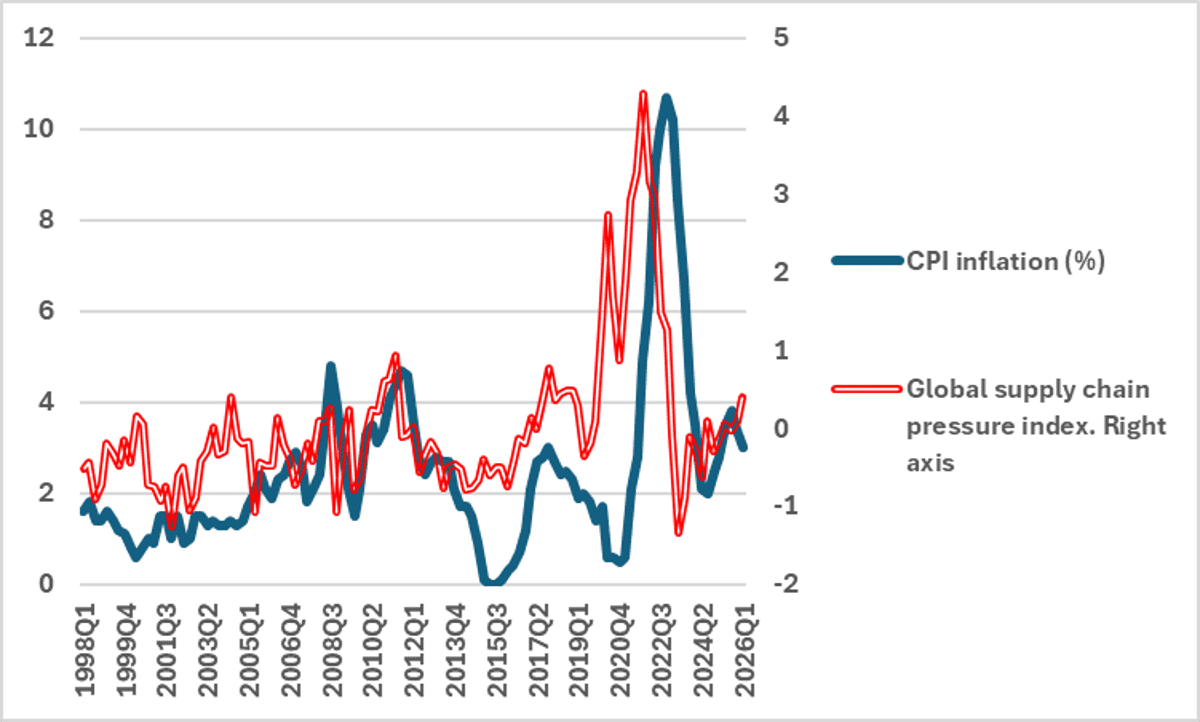
"Rachel Reeves and the BoE are (still) hoping for inflation to revert back to the target before May. The latest geopolitical developments might challenge this. From the plot below, CPI inflation correlates positively with global supply pressures.
Global supply pressures precede CPI inflation which, unfortunately, is already happening! Both global supply pressures and an (imminent) increase in the price of oil are exogenous factors with strong predicting power for UK inflation.
Since the BoE can do nothing about these exogenous sources of inflation, it looks more likely than not that (as things stand) Bank Rate will remain at 3.75% for longer."
reports that cruise operator MSC is keeping its Euribia ship docked in Dubai due to the conflict.
MSC Cruises stated:
"Following guidance of regional U.S. military authorities to keep MSC Euribia ship in port of Dubai."
The company is actively communicating with embassies and foreign offices to obtain relevant information about their nationals onboard and to understand any repatriation plans.
UK Mortgage Approvals Reach Two-Year Low
Outside the Middle East, the UK housing market slowed at the start of 2026, according to new data.
The Bank of England reported that 59,999 new mortgages were approved in January, the lowest figure since January 2024.
This slowdown occurred despite a decrease in the effective interest rate on new mortgages, which fell to 4.09% in January from 4.15% in December.
Net borrowing of mortgage debt by individuals declined to £4.1 billion in January, down from £4.5 billion in December and below the previous six-month average of £4.5 billion.
Gold, traditionally a safe haven during times of turmoil, reached a one-month high today.
Gold prices rose 2.2% to $1,792 an ounce, hitting their highest level since 30 January.
Susannah Streeter, chief investment strategist at Wealth Club, said:
"Precious metals prices have ratcheted up again, with gold and silver increasingly sought after in these turbulent times. Gold has reached a one-month high, after recording its seventh consecutive monthly gain in February - the best winning streak since 1973. Back then, a severe oil shock led to a flight to safe havens. While oil prices have increased sharply, this is not yet mirroring the 1970s surge, when prices effectively quadrupled in just a few months after Gulf countries retaliated against US support for Israel in the Yom Kippur War.
However, with tensions escalating and uncertainty so high, it is far from clear how this current conflict will evolve, and prices could climb even higher. This time around, other worries are also colliding to push up precious metals prices, including high debt levels, concerns over the Federal Reserve’s independence, and questions about the sustainability of the artificial intelligence boom."
European Travel Shares Decline Amid Conflict
Travel company shares across Europe are falling sharply as the US-Israel conflict with Iran disrupts flights and deters travel to the region.
Shares in TUI, Europe’s largest travel company, dropped 7% in early trading, while British Airways-owner IAG declined 5.5%, after initially losing 9%.
Lufthansa and Air France-KLM both fell 7%, while London-based cruise operator Carnival dropped 7.1%.
Wall Street futures indicate losses at the open in New York in under six hours.
Victoria Scholar, head of investment at interactive investor, said:
"US futures are pointing to notable declines at the open on Wall Street with Nasdaq futures down around 2% and S&P and Dow futures down around 1.5% each."
European bank stocks are down 3.9% so far this morning, on track for the largest one-day drop since Donald Trump announced sweeping tariffs in April 2025.
Generali Investments Warns of Oil Surpassing $100 Due to Gulf Crisis
Paolo Zanghieri of Generali Investments expressed concern that a rapidly escalating Gulf crisis could push oil prices above $100 per barrel.
Currently, Brent crude is up 9.5% today, trading at $79.85 per barrel.
Zanghieri emphasized that reopening the Strait of Hormuz is crucial to preventing further price spikes:
"The coordinated attacks by Israel and US on Iran are explicitly aimed at regime change and will likely last much longer than the limited action seen in 2025, when Brent briefly exceeded 80US$/barrel.
Iran has retaliated by targeting Israel, US bases in Gulf states, and closing the Strait of Hormuz, while Houthi rebels pledged renewed attacks in the Red Sea. This escalation is meant to pressure Gulf states to seek de-escalation. Iran’s Kharg Island oil terminal was attacked, but Gulf states’ infrastructure remains untouched.
Closing Hormuz could cut around 15–20% of global oil output. OPEC+ decided to boost supply by 206,000 barrels per day, and spare capacity (just under 3 million barrels per day) could theoretically offset lost Iranian exports (1.6 million), while OECD reserves are within normal range. Yet, preventing oil prices from breaching US$100/b depends on reopening Hormuz.
The Iranian navy is likely too weak for a full blockade, but partial disruption through sporadic attacks on ships and mining the Strait could push prices to US$90 or above. Direct strikes on Gulf oil facilities would sharply raise prices but also compromise Iran’s already weak regional ties and upset China."
UK Gilt Yields Rise Amid Middle East Conflict
UK government borrowing costs are increasing as investors reduce expectations for Bank of England interest rate cuts.
Yields on short- and longer-dated gilts have risen by between 3 and 4 basis points in early trading.

India and Canada Agree on Uranium and Critical Minerals Deals
In New Delhi, India and Canada have finalized agreements covering critical minerals and uranium supply.
The pacts, which also include technology cooperation and promotion of renewable energy use, were announced following talks between Indian Prime Minister Narendra Modi and Canadian official Mark Carney.
Both leaders expressed optimism about a renewed relationship between their countries.
"Our ties have seen a new energy, mutual trust, and positivity."
Carney added:
"This is not merely the renewal of a relationship. It is the expansion of a valued partnership with new ambition, focus, and foresight, a partnership between two confident countries charting our own course for the future."
The rise in oil prices may complicate central banks' efforts to reduce interest rates swiftly.
The probability of a Bank of England rate cut in March has fallen to 68% this morning, down from 80% last week; higher energy prices will make it more difficult for the BoE to reduce inflation to target levels.
European Stock Markets Decline
European stock markets opened lower, with major indices firmly in the red.
Emma Wall, chief investment strategist at Hargreaves Lansdown, noted a flight to safety benefiting gold and the US dollar:
"Events in the Middle East over the weekend – the US-Israel strikes on Iran, and subsequent retaliations across the region – have added uncertainty, and volatility, to an already choppy market. Global equities, buffeted by AI disruption fears and ever-changing tariff policy over recent months, are now digesting the likelihood of significantly higher oil prices, supply chain concerns, and the potential for subsequent higher inflation.
Investors have reacted by turning ‘risk-off’, buying into the perceived safe havens of gold, the US dollar and the Swiss franc. Initial equity market reaction was mixed. Middle Eastern markets trading yesterday fell – but only by 2-4% as key oil producers listed in the region provided a counter to wider losses.
Investors globally are broadly selling equities to fund the risk-off pivot, but the energy sector looks set to gain. US treasury bonds and UK gilts are also expected to benefit."
BAE Systems Shares Surge
Shares in defense manufacturer BAE Systems rose 7% at the start of trading in London as investors increased exposure to defense stocks.
European rivals also rallied, including Swedish aerospace and defense company Saab (+5.9%) and Italy’s Leonardo (+4.8%).
Conversely, IAG, the parent company of British Airways, fell 9.5% at the start of trading, making it the largest decliner on the FTSE 100.
FTSE 100 Drops 1% at Market Open
London’s stock market opened with investors reacting to the US-Israel conflict with Iran by selling shares in travel companies and banks while buying oil producers.
The FTSE 100 index declined by 1%, down 111 points to 10,798.
Budget airline easyJet (-6.2%) and Intercontinental Hotels (-5.8%) were among the biggest decliners, as traders anticipate reduced business in the Middle East due to thousands of flight cancellations.
Informa, a conference organizer with many events in the Middle East, including one scheduled for late March, fell 6.2%.
Meanwhile, the surge in crude prices boosted Shell (+5.7%) and BP (+6.3%) to the top of the FTSE 100 gainers.
Pound Weakens as US Dollar Strengthens
The US dollar strengthened by 0.8% this morning as investors sought its safety amid the crisis.
The pound fell 1%, or 1.3 cents, to $1.3346.
However, in the longer term, the attacks could accelerate the gradual decline of the dollar’s global dominance.
European Gas Prices Surge
European natural gas prices surged amid fears that the US-Israel conflict with Iran could disrupt global energy supplies.
Benchmark futures rose as much as 25%, the largest increase since August 2023, according to Bloomberg, following the near halt of tanker traffic through the Strait of Hormuz over the weekend.
Dutch front-month futures, Europe’s gas benchmark, increased 20% to €38.44 per megawatt-hour in early trading in Amsterdam.
Introduction: Geopolitics Push Oil Prices Up and Impact Stocks
Good morning, and welcome to our continuous coverage of business, financial markets, and the global economy.
The Middle East conflict has introduced new geopolitical uncertainty, with investors assessing the risk of oil supply disruptions that could hinder global growth and increase inflation.
The US-Israeli strikes on Iran, which began last weekend, have prompted investors to drive oil prices higher and stock markets lower.
Brent crude, the international benchmark, surged 13% at the start of overnight trading to $82 per barrel, a 14-month high. It is currently up 9% at $79.12 per barrel.
This follows reports that Tehran warned tankers in the Strait of Hormuz that no ships would be allowed passage. Approximately 20% of global oil transits the strait, so any disruption could cause supply shortages and price increases.
Insurers have also warned shipowners they would cancel policies and raise coverage costs for vessels traveling through the Gulf and the strait.
Jim Reid of Deutsche Bank explained:
"The spike comes as tanker traffic via the Strait of Hormuz has largely stopped with Iran having attacked three oil tankers over the weekend, though Iran’s foreign minister said on Sunday that Iran was not seeking to close the strait.
There is a view that ahead of the mid-terms, the US administration will do what they can to ensure Iran struggles to block the Strait for long. Investors will also be watching the extent of damage to Iran’s oil export facilities."
In Tokyo, the Nikkei 225 fell nearly 2.4% as Asian traders reacted to the weekend’s events, before partially recovering to a 1.35% decline in late trading.
Other markets also declined, with Hong Kong’s Hang Seng down 2%.
Middle Eastern markets fell yesterday, with Saudi Arabia down 2.2%, Bahrain down 1%, and Kuwait suspending trading entirely.
The Agenda
- 7am GMT: Nationwide February House Price Index
- 9am GMT: Eurozone manufacturing PMI for March
- 9.30am GMT: UK manufacturing PMI for March
- 9.30am GMT: Bank of England mortgage approvals and consumer credit data
- 12.30pm GMT: Bank of England policymaker Alan Taylor speaks at Norges Bank monetary policy regulation conference
- 2pm GMT: ECB President Christine Lagarde speaks at ECB International Women’s Day event