FTSE 100 hits four-month high
Britain’s leading stock index reached its highest point since early March amid growing optimism linked to geopolitical developments and economic data. The FTSE 100 rose to 10,701 points this morning, marking a 0.4% increase and its peak since 3 March.
Top performers included precious metals miner Fresnillo, which gained 2.5%, engineering firm Weir Group up 2%, and energy company SSE, which rose by 1.8%.
Several factors contributed to the FTSE 100’s rise, including hopes for a US-Iran peace agreement that have led to a decline in oil prices. Additionally, a weaker-than-expected US employment report released yesterday has eased concerns about imminent US interest rate hikes.
Dan Coatsworth, head of markets at AJ Bell, explained:
“Weak jobs numbers would normally be a key reason for central banks to consider cutting rates to stimulate the economy. The latest US jobs data confirms labour market disappointment but we’re nowhere near the stage where the Fed will reach for the monetary policy scissors to start cutting. We’re more likely to see an adjustment to the Fed’s assessment that implies no change to rates, which is still a win for markets.
Thirdly, investors are ‘rotating’ out of chip stocks (following a stellar start to the year) and into ‘old economy’ companies instead, and there are plenty of those on the London stock market.”
Global food prices dip in June
Global food commodity prices have decreased slightly, offering some relief to consumers worldwide. The United Nations Food and Agriculture Organisation (FAO) reported that its Food Price Index, which tracks a basket of consumable products, fell by 0.3% month-on-month in June.
While prices for vegetable oils and meat increased, these were offset by declines in sugar, cereals, and dairy products.
Cereal prices dropped by 3.5% in June, attributed by the UN to rapid harvest progress and strong supply prospects in the Black Sea region. This decline outweighed concerns about crop conditions in the United States and Australia amid fears of El Niño-related droughts.
Sugar prices fell by 5.7%, driven by lower domestic ethanol prices in Brazil, which encouraged more sugarcane to be used for sugar production, alongside strong sugar exports supported by the depreciation of the Brazilian real against the US dollar.
Dairy prices decreased by 1.5%. Skim milk powder prices declined due to recovering output in the EU and improved availability in the US, while butter and cheese prices were pushed down by increased milk availability and production.
Conversely, vegetable oil prices rose by 3.8% in June. The FAO noted that palm oil prices rebounded due to expectations of tighter export availability from Indonesia. Additionally, global rapeseed oil prices increased, influenced by biofuel demand and adverse weather conditions affecting plantings in Australia and Canada.
Meat prices edged up by 0.4%, with increases in poultry and ovine prices, while pig and bovine meat prices declined.
European stock markets are rallying today, following a record-setting day for America’s Dow Jones Industrial Average.
Chris Beauchamp, chief market analyst at investing and trading platform IG, commented:
“June was a spectacular month for the old-economy index that is the Dow Jones, which saw it rally sharply even as the surge in the Nasdaq hit a wall. The index has clocked up new record highs on both days of July trading, and active futures have pushed higher this morning. This is the kind of healthy action investors want to see, as different leadership emerges, while the weaker payroll report has restarted the ‘bad news is good news’ routine, since it helps to push back the dreaded idea of Fed rate hikes. Chip stocks are being punished for sky high valuations, but the consolidation has yet to turn into anything more serious.”
The Stoxx 600 is on track for its largest weekly gain since mid-May.

European markets at record high
Stock markets across Europe are also experiencing gains. Germany’s DAX index reached a record high, increasing by 0.7%. This rise contributed to the pan-European Stoxx 600 index climbing 0.35% to a new intraday high.
These developments have reduced the likelihood of further eurozone interest rate hikes later this year.
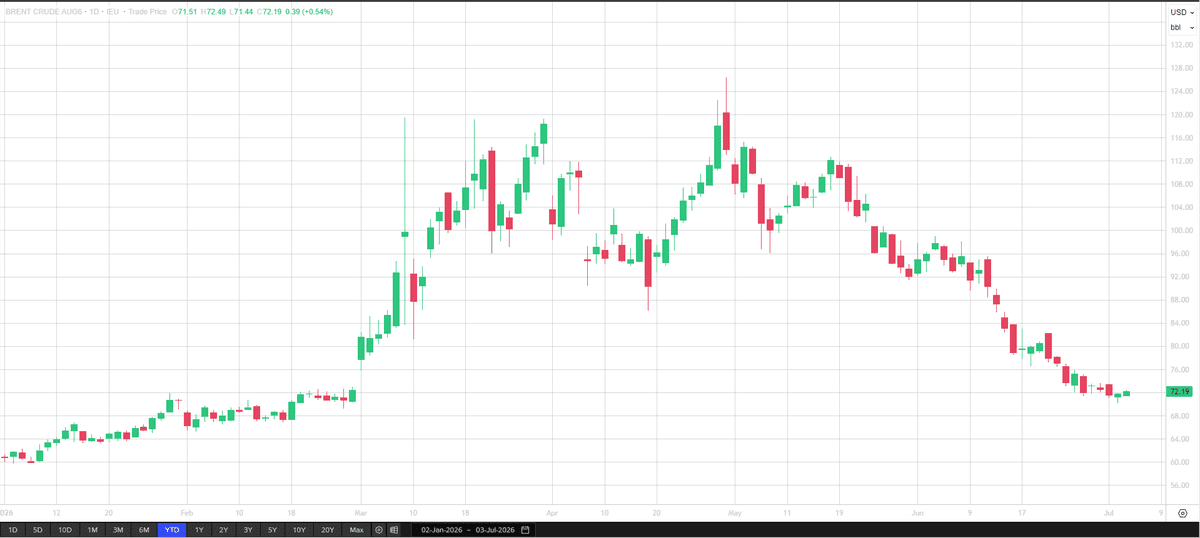
Chart: How oil fell back to pre-war levels
Oil prices have retreated to levels seen before the Iran conflict began, influenced by improving geopolitical conditions and market fundamentals.
Voyages through the Strait of Hormuz have increased
Maritime traffic through the Strait of Hormuz has surged in the past week, reflecting increased confidence in the US and Iran’s 60-day ceasefire, according to the Financial Times.
The number of traceable ship journeys passing into and out of the Gulf each day rose from between one and two during most of the conflict to eight on 1 July, based on a moving seven-day average from maritime data platform Signal.
Including ‘dark voyages’ (untraceable ship movements), total transits into and out of the Gulf reached 258 in the week ending 28 June, up from 41 in the first week of the crisis in March, according to Lloyd’s List Intelligence data.
Introduction: Oil may fall to $60 a barrel, Citi says
Good morning, and welcome to our continuous coverage of business, financial markets, and the global economy.
Recent optimism about peace in the Middle East has contributed to a decline in oil prices, with further decreases anticipated.
Analysts at Citigroup forecast that Brent crude oil could fall to $60 per barrel by the end of the year, a price last observed in January. Brent has already dropped from $126 per barrel at the end of April to $72 this morning, erasing the price surge triggered by the Iran conflict.
Francesco Martoccia of Citi stated:
“Fundamentals are rapidly reasserting themselves. Shipping flows are normalizing, Chinese buyers remain absent, physical crude markets have weakened sharply, and inventories have drawn far less than expected.”
Crude prices have declined following the resumption of shipping through the Strait of Hormuz, as the US and Iran work toward a peace agreement.
On Wednesday, the two parties held indirect talks in Doha, focusing on maritime traffic in the Strait of Hormuz and the unfreezing of Iranian funds. These discussions have since been paused as Iran conducts a funeral ceremony for Ali Khamenei, the supreme leader killed on the first day of the conflict.
Despite progress, the risk of renewed conflict remains.
James Hosie, equity analyst at Shore Capital, cautioned:
“The current US-Iran ceasefire remains fragile after an Iranian drone strike on a Panama-flagged oil tanker last week was followed by both sides targeting regional military sites. At this stage, the attacks do not appear to have materially disrupted vessel owners’ willingness to navigate the Strait.
A return of blockades could cause a spike in Brent back above $100 per barrel, although we would anticipate markets pricing in such disruption with the assumption that it is very temporary and becoming a catalyst for further ceasefire talks. A breakdown in diplomacy leading to a resumption of daily missile strikes between the US or Israel and Iran could result in a return to higher oil prices for a more sustained period.”
The agenda
- 9am BST: UN’s FAO Food Price Index release
- 9am BST: Eurozone service PMI report for June
- 9.30am BST: UK service PMI report for June