Introduction: Oil rises with US-Iran ceasefire 'on tenterhooks'
Good morning, and welcome to our continuous coverage of business, financial markets, and the global economy.
Market complacency regarding a potential resolution to the Middle East conflict has dissipated today amid growing concerns that the ceasefire between the United States and Iran may not hold.
Following a decline on Friday when the Strait of Hormuz was declared reopened, oil prices are now climbing after Iran announced the waterway was closed once more.
Tehran accused Washington DC of maintaining its own blockade on Iranian ports; in response, the US seized an Iranian-flagged cargo ship attempting to transit the strait.
“We have full custody of their ship, and are seeing what’s on board!” posted Donald Trump on social media.
With Iranian state media reporting that Tehran currently has no plans to engage in new talks with the US, oil prices have surged.
Brent crude, which dropped 9% on Friday, has increased by 5% so far today, reaching $95.60 per barrel.
Kyle Rodda, senior financial market analyst at capital.com, noted there had been “a high degree of complacency” that the ceasefire would hold and a peace agreement would be reached. He added:
“The markets are set for a spicy start to the week, with initial moves in futures and FX violent. Tensions about the control and closure of the Strait of Hormuz have flared again, threatening peace talks between the US and Iran.”
Although the ceasefire has not formally collapsed, it remains fragile after Iran reversed its decision to lift its blockade, citing the US’s continued blockade of Iranian ports. Iran has fired on ships attempting to pass through the Strait and forced them to turn back, while the US took control of an Iranian-flagged vessel by force.
While hopes persist that both sides will seek de-escalation, there is an increased risk that they will not, potentially plunging the global economy further into an energy crisis.
The agenda
- 7am BST: German producer prices for March
- 10am BST: Eurozone construction output for February
- 1.30pm BST: Canadian inflation for March
European stocks fall as 'Hormuz chaos' leaves markets on edge
European stock markets opened lower today as last Friday’s optimism regarding a Middle East peace deal faded.
In London, the FTSE 100 declined by 42 points, or 0.4%, to 10,626 points, retreating from a six-week high reached at the end of last week.
Germany’s DAX fell by 1.3%, and Italy’s FTSE Mib dropped 1.1%.
The turmoil surrounding the Strait of Hormuz has unsettled markets, according to Chris Beauchamp, chief market analyst at investing and trading platform IG:
“Friday’s euphoria has given way to confusion around the status of Hormuz. While Iran has declared it closed, markets seem to be, as ever during this crisis, looking on the bright side.
US futures are down, and Europe is expected to open lower, but most of the gains are still intact. And oil futures aren’t back to where they were early Friday. If talks do get underway that will help support risk appetite, but this is far from a foregone conclusion that they will even begin right now.
A clear way out of the crisis is still impossible to foresee, and meanwhile the energy crisis continues to worsen by the day.”
European gas prices have also increased.

Europe’s benchmark month-ahead gas contract is up 5.7% at approximately €41 per megawatt hour.
UK to 'flirt' with recession as Iran war oil shock bites, report warns
Economists predict that the economic impact of the Middle East crisis will leave the UK close to recession.
The EY Item Club forecasts that the UK economy will stagnate during the second and third quarters of this year, with unemployment expected to rise.
UK gas price rises
Gas prices are also increasing this morning.
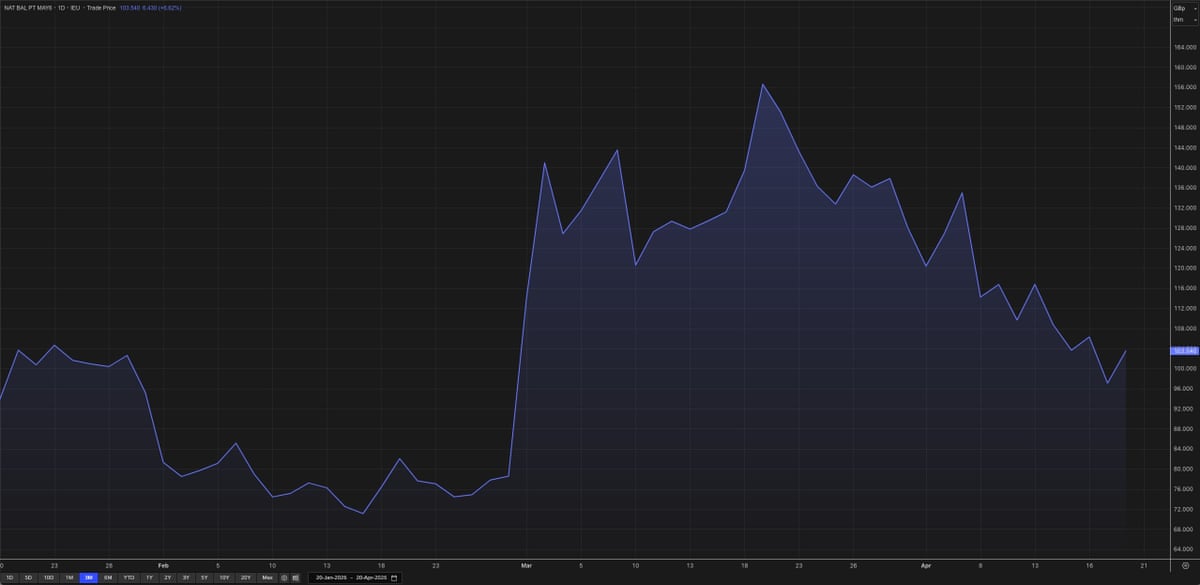
The month-ahead UK gas price has risen over 6% to 103p per therm.
Although this remains below last month’s peak of 180p, it is significantly above the 80p per therm levels recorded prior to the onset of the Iran conflict.
UK advertising group M+C Saatchi has warned shareholders this morning that the Iran war is likely to adversely affect its business this year.
“Macroeconomic challenges remain, while the conflict in the Middle East is likely to significantly impact our sport and entertainment and consumer-facing business.”
M+C Saatchi also reported a 7.3% decline in like-for-like net revenues, attributing this to last year’s US government shutdown in Q4, the consequences of Donald Trump’s tariffs, and a “tough macroeconomic environment.” Like-for-like profits fell 26%.
Middle East crisis: What the analysts say
Mohit Kumar of investment bank Jefferies remains optimistic that the US and Iran are progressing towards a peace deal despite the re-closure of the Strait of Hormuz:
“Markets are in a risk off mode this morning as tensions have escalated with Iran closing the Strait of Hormuz and US blockade still in place. US seized an Iran cargo ship and Trump threatened to destroy power plants and bridges in Iran. Tensions have also escalated between Israel and Hezbollah with the killing of two Israeli soldiers and attacks on Southern Lebanon. This follows constructive talks last week, where US and Iran were moving towards a deal and Iran had agreed to open the Strait of Hormuz.
Our view remains that we are moving towards a deal. Not because we believe that US and Iran have found a solution, but because of the MAD (Mutually Assured Destruction) principle. We are at a stage where it is not in the interest of either parties to carry on with the war. The MAGA base of Trump does not want war to continue and Trump wants a deal. For IRGC, the objective is survival and destruction of infrastructure and economic hardship could sow the seeds of rebellion down the line. For Israel, the main objective is the weakening of Hezbollah and would not hinder a US Iran deal.”
Jim Reid of Deutsche Bank suggests that recent stock market rallies may have been overly optimistic:
“Recent developments can be framed in two ways: either five steps forward towards peace and three back (seems more apt than three and two), or as evidence that the two sides remain far enough apart that a lasting deal will be extremely hard to achieve and markets have become far too optimistic. I lean more towards the former, but the comparison with recent history is uncomfortable.
Remember the 10%+ S&P 500 rally in the early weeks of the war in Ukraine, when hopes briefly grew of an early negotiated settlement, only to be disappointed. That episode is a clear warning sign.”
The weekend was marked by chaos in the Strait of Hormuz, as shipping restrictions were first lifted and then reinstated.
More than a dozen tankers, including three sanctioned vessels, passed through the Strait after a 50-day blockade was lifted on Friday.
These vessels took advantage of the brief window before Iran reimposed restrictions on Saturday. A UK maritime agency reported that Islamic Revolutionary Guard Corps (IRGC) ships fired at a tanker attempting to transit the strait on Saturday.
There was “a chaotic 24 hours” as operators tested the strait’s openness – while a small number of vessels successfully passed through on Saturday, most others turned back and abandoned their attempts.