

China Lowers Economic Growth Target Amid Domestic and Global Challenges
China has reduced its annual economic growth target to a range of 4.5% to 5%, marking the lowest expansion goal since 1991 as the country faces multiple challenges both domestically and internationally.
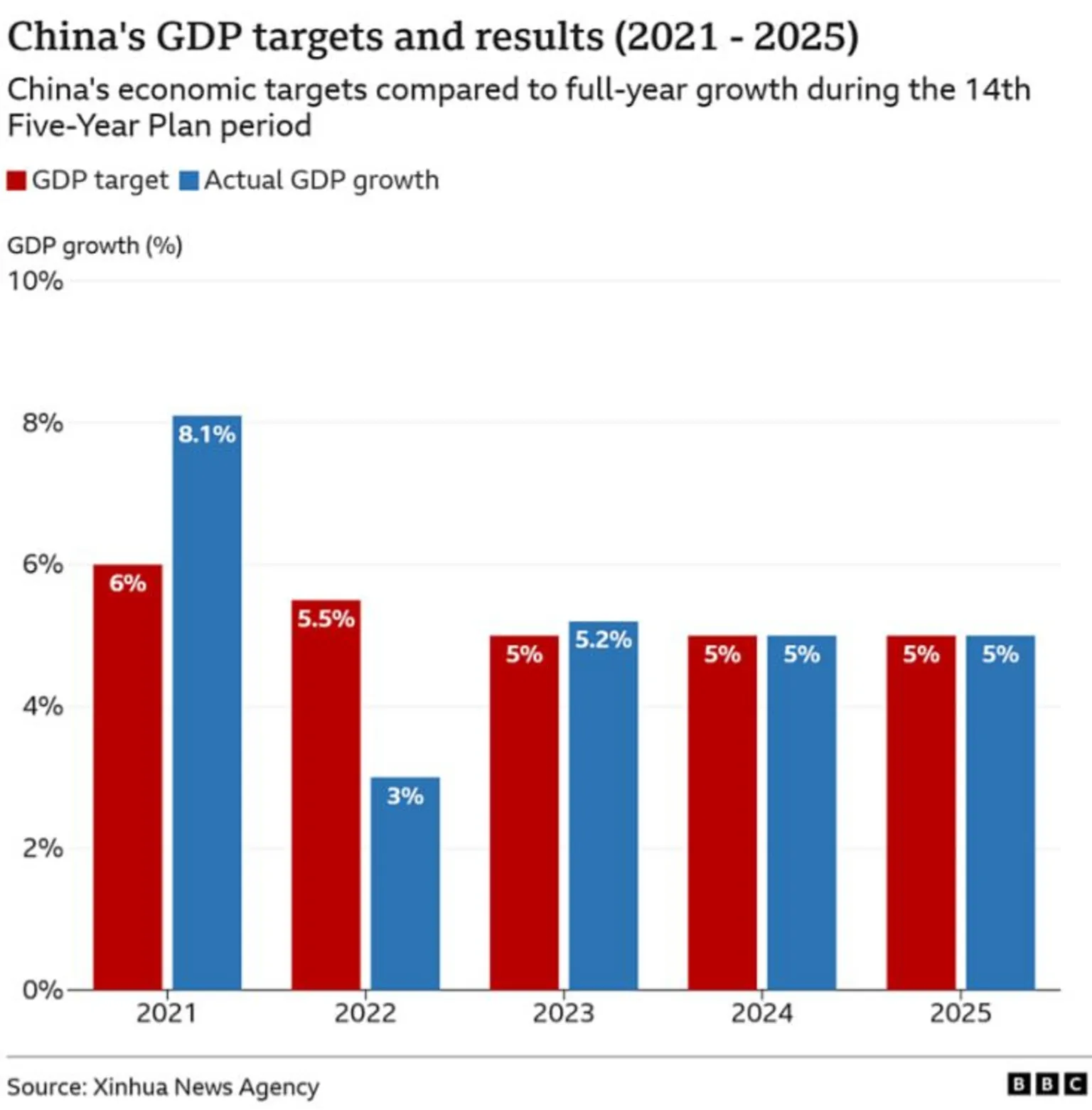
This adjustment represents the first time the target has been lowered since it was set at "around 5%" in 2023. Notably, no target was established in 2020 due to the uncertainties caused by the COVID-19 pandemic.
The announcement was made during China's major political event, commonly referred to as the "two sessions," where additional details of the 15th Five Year Plan for the world's second-largest economy were also unveiled.
This development occurs as Beijing seeks to transform its economy in response to issues such as weak domestic consumption, a persistent property market crisis, and ongoing trade tensions with Western countries.
The "two sessions" event, which commenced on Wednesday and typically lasts at least a week, convenes the nation's leaders for consecutive meetings.
Focus on Innovation and Consumption in Five Year Plan
Premier Li Qiang addressed delegates, stating that the Five Year Plan will emphasize investments in innovation, high-tech industries, scientific research, and enhanced efforts to stimulate household consumption.
"The Five Year Plan will include investments in innovation, high-tech industries, scientific research and more efforts to boost household consumption."
His remarks highlight Beijing's concerns regarding weak domestic consumption, which has made the country overly dependent on exports for economic growth. They also underscore ambitions to upgrade China's manufacturing sector.

Economic Performance and Provincial Growth Targets
In January, official data indicated that China achieved its 5% economic growth target for 2023 overall. However, Beijing also reported that economic expansion slowed to 4.5% in the final quarter of the year, hindered by subdued domestic spending and the ongoing property crisis.
More than two-thirds of China's provinces have reduced their growth targets, either by lowering the target figures or by modifying the language from aiming to exceed a certain rate to targeting "around" that level.
While China met its growth target last year, experts advise caution in interpreting these figures. Georgetown University policy researcher Ning Leng noted that the data should be taken with "a grain of salt," as other indicators suggest a weaker economic situation.
"While China hit its growth target last year, it should be taken with 'a grain of salt', as other data suggests a weaker economic picture," said Georgetown University policy researcher Ning Leng.
Chinese consumers have remained cautious in their spending habits, and the persistent real estate crisis continues to exert downward pressure on growth.
Manufacturing, Exports, and Trade Surplus
Manufacturing and exports have played a significant role in supporting China's economy, which recorded the world's largest-ever trade surplus last year. The surplus, representing the value of goods and services sold abroad compared to imports, amounted to $1.19 trillion (£890 billion).
However, China has become increasingly reliant on overseas sales to compensate for domestic weaknesses, a vulnerability that the United States has recognized, according to Ning Leng.
"China has become especially reliant on selling overseas to plug the gaps, which is a weakness the US can sense," Ning said.
US President Donald Trump's tariffs have further strained China's export-dependent economy.
In response, China has invested substantial resources to redirect trade towards other countries, ensuring its products remain marketable and sustaining its manufacturing sector, Ning added.
"China has responded by pouring huge resources to redirect trade with other countries to ensure its products can be sold, sustaining its manufacturing sector," said Ning.


