Bank now expected to raise interest rates twice this year
City traders anticipate that the Bank of England (BoE) will increase UK interest rates at least twice this year to address inflationary pressures stemming from the Middle East crisis.
Money markets are fully pricing in a quarter-point rise in the Bank rate to 4% by June, with a second hike to 4.35% expected by September. However, these implied interest rates have shown volatility today.
Traders are responding to the Bank’s updated forecast that inflation will average 3% in the second quarter of this year, a rise from the previously expected 2.1%. They also note that elevated energy bills are likely to lead to increased wage demands and higher retail prices.
European gas prices have retreated slightly from earlier highs but remain on track for significant gains today. The UK month-ahead gas contract has risen nearly 15% to 160p per therm, having peaked at 175p this morning. Meanwhile, the continental European month-ahead gas contract is up almost 16%, at €63.2 per megawatt hour.
Market participants have taken note of reports that Iran’s strikes on Qatar damaged facilities responsible for producing 17% of QatarEnergy’s liquefied natural gas (LNG) export capacity.
CEBR: UK energy bills on track to top £2,100
Consultancy CEBR projects that UK energy bills are set to exceed £2,100 annually due to the recent surge in oil and gas prices. This represents a significant increase over the current energy price cap.
CEBR’s calculations indicate that the upcoming quarterly price cap, which is based on wholesale energy prices, will rise sharply. The consultancy stated:
"The latest developments in the Middle East, including the recent strike on the Ras Laffan export facility, have pushed up wholesale energy prices. At current levels, this implies a Q3 Ofgem price cap exceeding £2,100 if sustained, with higher bills likely even if prices ease. The conflict is also expected to shave around 0.1 to 0.3 percentage points off UK GDP growth over the next year."
Gap between US crude and Brent has widened in crisis
Global oil prices have surged amid escalating military aggression targeting key energy infrastructure in the Gulf. However, US oil prices have remained relatively stable, posing a potential challenge for Asian economies.
The price differential between Brent crude, the international benchmark, and West Texas Intermediate (WTI), the US oil price, has reached an 11-year high as traders assess the disparate regional impacts of the global energy supply shock.
Brent crude rose over 10% to $119.13 per barrel earlier today, nearing the March 9 peak, driven by concerns that attacks on Gulf infrastructure could prolong supply disruptions affecting major energy consumers in Asia and Europe. It is currently up 4% at $111.62 per barrel.
Conversely, WTI has increased only 1.7% to $97.95 per barrel, reflecting the US’s strong domestic production and strategic reserves.
Asset manager Stephen Innes warned that while Brent typically trades at a premium to WTI, the current crisis risks becoming a "regional wrecking ball," forcing Asian and European economies to face higher oil prices and a stronger US dollar, which increases costs on the dollar-denominated market.
"If escalation continues, the next phase is not just higher oil but enforced behavioral change, where demand is rationed through price and inflation becomes embedded rather than episodic. That is when the shock evolves from a market event into an economic regime shift."
The UK interest rate predictions market has moderated slightly since earlier spikes. The market still fully prices in one hike by June and a second in September, but the likelihood of a third rise has disappeared from money market pricing.
Paul Dales, chief UK economist at Capital Economics, noted that the BoE appears to be leaning more towards rate hikes rather than cuts. He added:
"That said, in an unusual move presumably in response to the markets pricing in 75 basis points of rate hikes, 100 minutes after the policy announcement Governor Bailey was quoted as saying ‘I would caution against reaching strong conclusions about us raising interest rates’ and that ‘the markets are getting ahead of themselves in assuming rate rises’."
Prolonged high oil prices could ‘crimp’ AI boom, WTO warns
The World Trade Organization’s chief economist has cautioned that a sustained period of elevated oil prices due to the Middle East conflict could hinder the growth of artificial intelligence (AI) investment.
The war and its effects on energy and fertilizer costs represent the primary risk to the global economy identified in the WTO’s latest Global Trade Outlook.
The Geneva-based organization also expressed uncertainty about the continued strength of AI investment, which in 2025 helped offset the impact of tariffs on global trade.
The WTO has downgraded its forecast for growth in world trade in goods to 1.9% this year, down from 4.6% in 2025, and warned that if crude oil and liquefied natural gas prices remain high throughout 2026 due to the conflict, global trade growth could slow further to 1.4%.
BoE's Bailey: I'd caution against strong conclusions about rate hikes
Bank of England Governor Andrew Bailey suggested that financial markets may be overestimating the likelihood of multiple UK interest rate increases this year.
Following a sharp rise in rate hike expectations, Bailey told the BBC that traders should avoid drawing "any strong conclusions" about the trajectory of borrowing costs.
"I would caution against reaching any strong conclusions about us raising interest rates.... Today we’ve given a very clear message. The right place to be is on hold."
Wall Street joins the sell-off
New York stock markets opened with losses, though less severe than those seen in Europe today.
The Dow Jones Industrial Average fell by 205 points, or 0.44%, to 46,020 points in early trading. Boeing (-3.4%) and Caterpillar (-2.6%) were the largest decliners, as investors anticipate prolonged energy disruptions that could reduce demand for airlines and construction equipment.
The broader S&P 500 index declined by 0.5%. In contrast, Europe’s Stoxx 600 index dropped nearly 2.5%, while Japan’s Nikkei fell 3.4% overnight.

Iran attack damage wipes out 17% of Qatar’s LNG capacity for three to five years
Iran’s attacks on Qatar have damaged facilities responsible for 17% of QatarEnergy’s liquefied natural gas export capacity, potentially requiring three to five years for repairs, according to QatarEnergy CEO Saad al-Kaabi.
Speaking to a day after the attack on the Ras Laffan industrial complex, al-Kaabi indicated that Qatar may be unable to fulfill contracts during this period.
"I never in my wildest dreams would have thought that Qatar would be - Qatar and the region - in such an attack, especially from a brotherly Muslim country in the month of Ramadan, attacking us in this way."
He also stated to :
"We may have to declare force majeure on long-term contracts for up to five years for LNG supplies to Italy, Belgium, Korea and China."
European countries and Japan: ready to help on Hormuz, stabilise energy markets
Britain, France, Germany, Italy, the Netherlands, and Japan have expressed readiness to take measures to stabilize energy markets and participate in efforts to ensure safe passage through the Strait of Hormuz.
In a joint statement, these countries condemned Iran’s attacks and called for an immediate cessation of such actions.
"We express our readiness to contribute to appropriate efforts to ensure safe passage through the Strait. We welcome the commitment of nations who are engaging in preparatory planning."
The statement also welcomed the release of strategic petroleum reserves and added:
"We will take other steps to stabilise energy markets, including working with certain producing nations to increase output."
Why the Bank of England is really worried
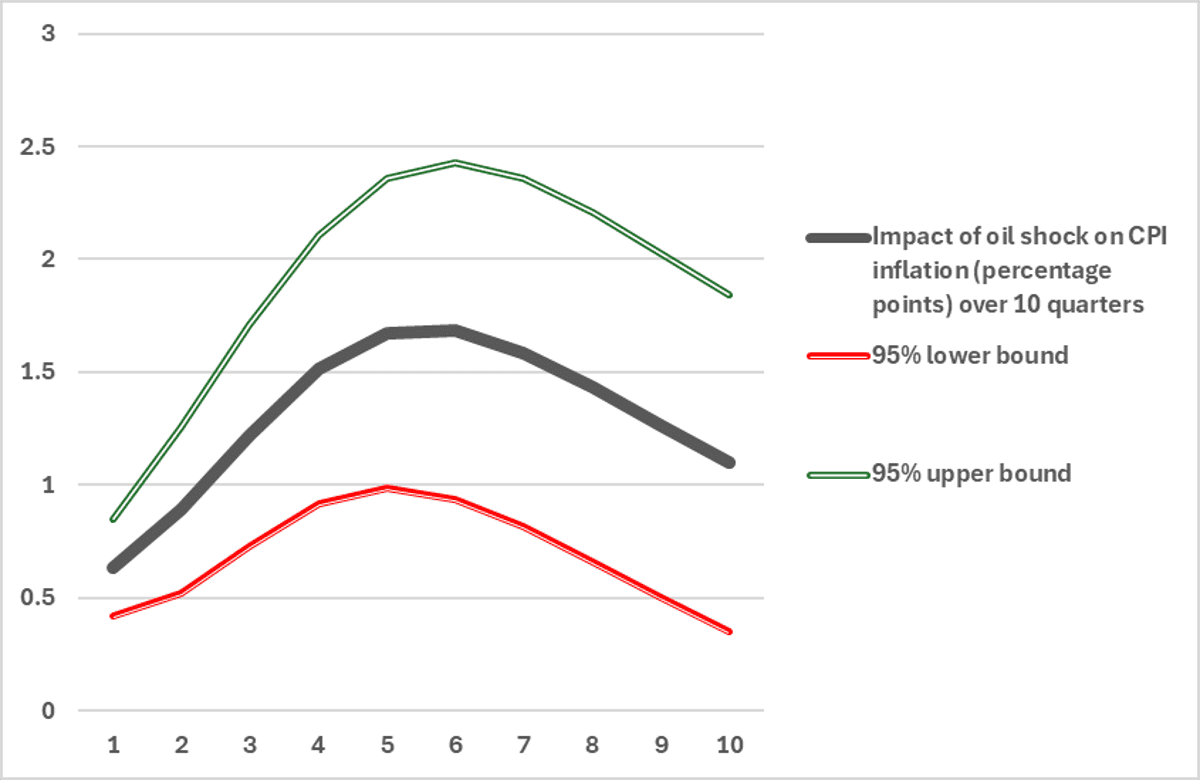
Professor Costas Milas of the University of Liverpool’s Management School explained the Bank of England’s Monetary Policy Committee (MPC) concerns regarding the inflationary impact of the oil shock.
He stated that if oil prices remain elevated for some time, UK inflation could rise by up to 1.5 percentage points by the end of the year and peak in early 2027. This impact is statistically significant within a model incorporating oil prices, inflation, UK growth, and Bank Rate.
This represents a severe oil price shock for the UK economy.
ECB leaves eurozone interest rates on hold and hikes inflation forecasts
The European Central Bank (ECB) has decided to maintain eurozone interest rates at current levels.
In its announcement, the ECB emphasized its commitment to ensuring inflation stabilizes at the 2% target over the medium term.
The ECB warned that the Middle East war has increased uncertainty, creating upside risks for inflation and downside risks for economic growth. It noted that the conflict will materially affect near-term inflation through higher energy prices, with medium-term effects dependent on the conflict’s intensity, duration, and impact on consumer prices and the economy.
The ECB also raised its inflation forecasts due to the Middle East war. It now expects headline inflation to average 2.6% in 2026, 2.0% in 2027, and 2.1% in 2028. These figures represent an increase from December’s forecasts of 2.2% in 2026, 1.9% in 2027, and 2.0% in 2028.
FTSE 100 share index dips below 10,000 points
London’s stock market selloff has intensified, with the FTSE 100 blue-chip share index falling nearly 3% today. It briefly dropped below the 10,000 point threshold, hitting 9,997.41 points—the lowest level since 8 January—before recovering slightly to 10,004 points.
Except for BP, which rose 2.5%, all shares on the index declined. Precious metal producers Fresnillo (-9.2%) and Endeavour Mining (-9%) led the selloff, with banks and mining companies also among the top losers.
Before the onset of the Iranian conflict, the FTSE 100 stood at 10,934 points, marking an 8.5% loss in value since then, affecting pension funds and Individual Savings Accounts (ISAs) across the UK.
The market turmoil triggered by the Middle East crisis continues to affect various assets. Silver prices have dropped nearly 11% to $67.1 an ounce, while gold has fallen 5.7% to $4,539 an ounce.
Two-year bond yields on track for biggest jump since 2022 mini-budget crisis
UK government bond prices have declined sharply following the Bank of England’s warning that the energy crisis could trigger "second round" effects, pushing inflation higher.
As bond prices fall, yields on UK gilts have risen significantly, particularly for shorter-dated bonds.
The yield on two-year gilts increased by 35 basis points to 4.47%, the highest level since January 2025. This marks the largest daily increase since the September 2022 mini-budget crisis.
Michael Browne, global investment strategist at Franklin Templeton Institute, suggested the Bank of England’s MPC faced a challenging meeting. He remarked:
"What should they do in the face of a very real inflationary threat? As we dust off the 2022 playbook, we know the damage energy driven inflation can inflict - but to use the Scottish legal term, it is not yet proven.
Last night, US markets sold off sharply after [Federal Reserve] chairman Powell failed to sound tough enough. Bond markets are nervous and need reassurance that monetary authorities are on top of their brief and prepared to raise interest rates sooner rather than later.
The minutes suggest the MPC is very alive to the risks and while that may not be enough for the market today, investors should be re-assured that they will act, even though a rate rise would be bad news for the economy."
In a scenario where the US and Israel had not attacked Iran on 28 February, a rate cut today would likely be under consideration. Prior to the war, money markets assigned an 80% chance to a rate cut.
Bank deputy governor Sarah Breeden stated that she would have expected to vote for a cut today if circumstances had not changed:
"Conflict in the Middle East has significantly shifted the outlook for inflation. Absent this shock, the underlying disinflation process had continued broadly as I expected and, consistent with my vote in February, I would have expected to vote for a cut again in March. But the conflict will have a significant, though at this point highly uncertain, impact on inflation."
Why are mortgage rates going up when the Bank of England base rate hasn’t changed?
Although the Bank of England has kept the base rate unchanged today, mortgage rates have been rising since the onset of the Iranian conflict.