Exclusive: Government and Developers Admit Power Supply Issues at Lanarkshire AI Datacentre Site
A major AI datacentre project in Lanarkshire, Scotland, promoted as a source of jobs and economic growth, has been found to have misrepresented its capacity to be powered entirely by on-site renewable energy, according to an investigation by .
Announced in January, the £8.2 billion AI datacentre complex, developed by US firm CoreWeave and Scottish company DataVita, was publicly presented as being fully powered by renewables and completed by 2030. This project is a significant component of the UK’s strategy to maintain competitiveness in the global AI sector by establishing critical infrastructure.
However, documents obtained via freedom of information (FoI) requests and public record analysis indicate that the datacentre is unlikely to meet its renewable energy goals.
Internal correspondence reveals that while the government and developers publicly promised up to 1GW of new energy infrastructure at the Lanarkshire site, they privately acknowledged a "power provision" issue that would prevent this from materializing.
When questioned by , government representatives stated that the Lanarkshire complex would connect to the national grid, which implies either a lengthy wait in a queue or prioritization over other projects seeking grid access. A government spokesperson asserted that the site's energy needs would still be met "overwhelmingly" by renewables.
These findings cast doubt on the UK’s capacity to address the critical challenge of supplying the substantial energy demands of large-scale AI infrastructure.
‘At Best Indicative, at Worst Complete Bunk’
AI datacentres consist of buildings housing specialized silicon chips that perform the computations underlying AI models. Leading technology companies worldwide are investing hundreds of billions of dollars in expanding AI datacentres, driven by expectations that AI will transform the global economy and that these datacentres will become financially self-sustaining.
The viability of AI as an economic driver increasingly depends on infrastructure projects like the Lanarkshire development.
This is not the first indication of challenges within the UK’s growing datacentre sector. In March, reported that several high-profile projects announced in recent years were "phantom investments," with the government failing to verify job creation claims or audit multibillion-pound expenditures.
Power supply is a particularly acute challenge in the UK, where electricity costs are the highest in Europe. New developments face an eight- to 10-year wait to connect to the grid, a delay affecting not only datacentres but also residential and healthcare facilities.
Similar issues exist internationally. Cecilia Rikap, associate professor at University College London, commented:
"Governments around the world, including in the UK, are making political promises that ignore the realities of building infrastructure. Instead of governing for their communities, they choose the AI narrative."
An analyst from a UK engineering consultancy involved in advising AI growth zone projects stated:
"There doesn’t seem to be appropriate scrutiny, public or otherwise, on these nationally significant projects. The figures and designs behind many schemes are at best indicative, and at worst complete bunk."
From ‘No Plans’ to Britain’s Largest Onshore Windfarm
DataVita, the developer of the Lanarkshire complex, claims it will supply the site in Airdrie with over 1GW of renewable energy, comprising 400MW of solar power and 800MW of wind energy. This exceeds by more than 1.5 times the output of Whitelee, the UK’s largest onshore windfarm, which covers an area half the size of Bristol and generates approximately enough power for 800,000 Scottish homes.
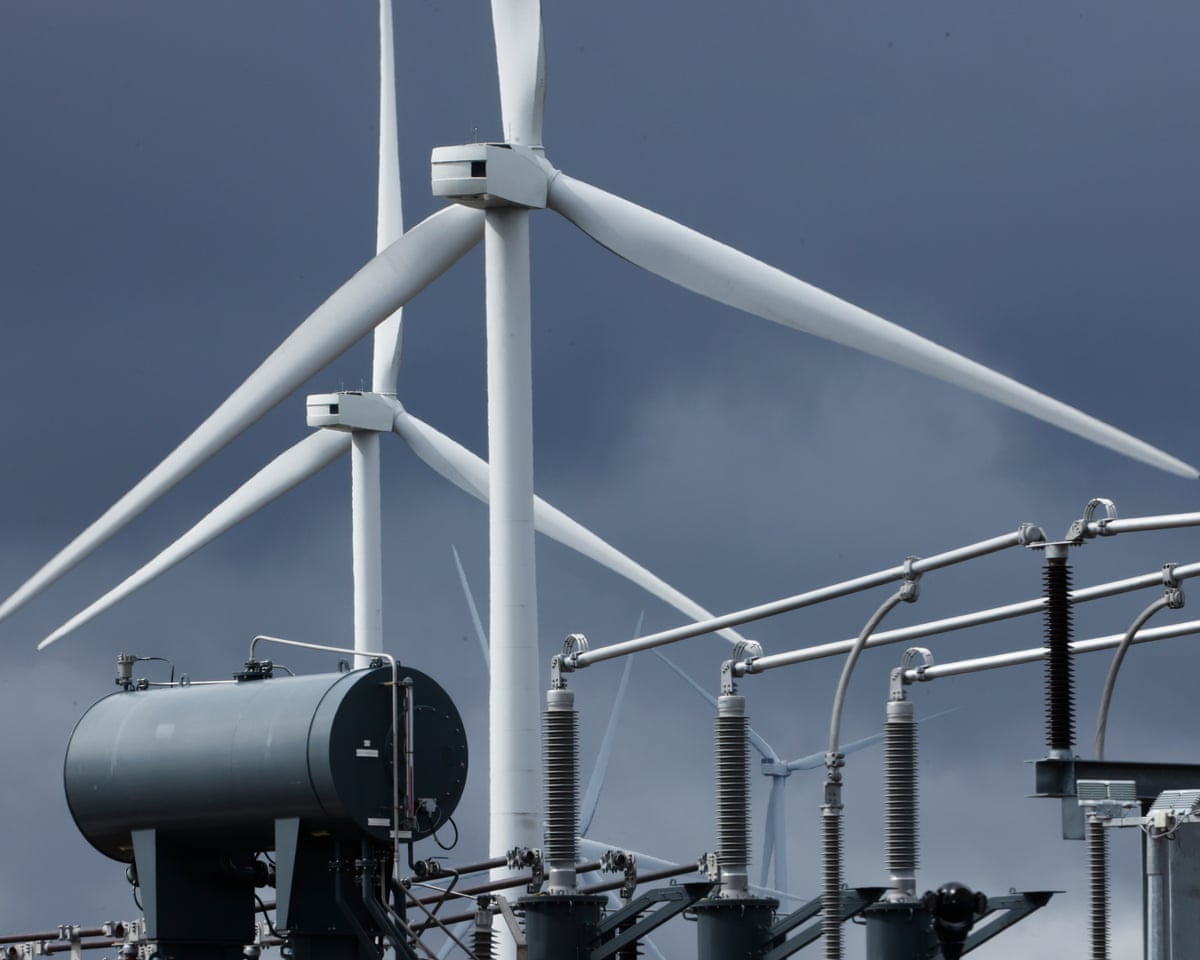
DataVita’s website suggests that all these energy sources are privately connected, describing "energy parks" directly linked to its datacentres, providing power equivalent to a small nuclear reactor.
However, there is no evidence that DataVita currently operates 1GW of private-wire renewable energy at its datacentres or that it will do so soon. Presently, the company operates two smaller datacentres in Glasgow and Chapelhall (the Lanarkshire hub), which together draw about 25MW from the grid. DataVita did not respond to inquiries regarding existing renewable installations.
Moreover, there is scant evidence that DataVita will secure the necessary land to realize these renewable energy ambitions. Analysis by the Edinburgh-based charity Action to Protect Rural Scotland (APRS), reviewed by an energy consultant specializing in datacentres, estimates that DataVita’s renewable energy plans would require between 40 and 100 square kilometers of land.
Current planning applications cover approximately 2 square kilometers in Lanarkshire, according to APRS analysis. DataVita’s website claims ownership of "over 1,000 acres" (about 4 square kilometers) of renewables.

The energy consultant remarked:
"To go from ‘nothing public’ to ‘country’s largest operational onshore windfarm’ in four years is pretty ambitious."
Given the absence of filed plans for such developments, the consultant concluded that the 2030 completion target is unlikely.
HfD Group, DataVita’s parent company, recently submitted plans for an "energy park" in Lanarkshire, which have yet to enter the planning process. These plans include up to 19 wind turbines, which would generate only about 5% of DataVita’s claimed energy output.
DataVita stated that its energy commitments depend on "final commercial agreements, planning, grid and consenting processes."
Kat Jones, director of APRS, said:
"There is a wave of applications for hyperscale AI datacentres coming to Scotland and they all say they’re going to use renewable energy. We have examined DataVita’s plans to build renewables to power their 500MW datacentre and found them wanting.
Even if they could build the amount of energy infrastructure they say they will, it would cover 100 kilometres squared, but only provide for half their energy requirements on average."
‘Power Provision Remains a Key Issue’
This energy shortfall extends beyond DataVita. Lanarkshire, designated as an AI "growth zone," is a central element of the UK’s AI infrastructure strategy, one of five sites selected for government support to develop large datacentre parks.
AI growth zones must meet stringent criteria, primarily demonstrating a feasible plan for self-powering. These criteria were outlined in a government application process last summer inviting UK sites to apply for growth zone status.
Applicants were required to show either an allocated grid connection or an alternative "behind-the-meter" solution, meaning independent energy generation without reliance on the grid.
confirmed through an FoI request to the UK’s National Electricity System Operator (Neso) that the Lanarkshire site lacks the necessary grid connection. DataVita’s plans for self-generated electricity also appear unsubstantiated.
FoI documents indicate that both the government and DataVita are aware of these challenges but proceeded to designate Lanarkshire as an AI growth zone regardless.
In February, Scotland’s First Minister John Swinney wrote to DataVita’s managing director, Danny Quinn, regarding the AI growth zone designation, stating:
"I recognise that power provision remains a key issue and we will continue to engage with the UK government and relevant partners to secure timely grid connections that enable and support the development to proceed at pace."
In a March meeting, DataVita and NatureScot officials appeared to anticipate an expedited grid connection, expecting Scottish Power to advance connection timelines to 2027.
Other internal communications reveal that prior to the project announcement, UK and Scottish officials considered the possibility that DataVita might use gas to power the site. DataVita has denied any use of gas or fossil fuels for powering its datacentres.
The consultant noted that DataVita’s publications lack clear explanations of how the claimed energy generation would be achieved, raising questions about the government’s policymaking regarding this key growth plan component.
"It indicates that the AI growth zone designation is based more on optimistic and flashy promotional material than anything technically viable," he said.
Regarding the government’s apparent willingness to assist DataVita in securing a grid connection, the consultant added:
"It now appears that the government is willing to loosen their own criteria to meet the arbitrary political timescales they set themselves."
DataVita responded to , stating:
"The Lanarkshire development’s energy strategy is based on new renewable generation, private-wire infrastructure, and intelligent connection to Scotland’s electricity system, with delivery subject to final commercial agreements, planning, grid and consenting processes."
A government spokesperson said:
"The Lanarkshire AI growth zone is on track to be the biggest datacentre development in Scottish history. AI is critical to the UK’s future prosperity and security – and to unlock its benefits, we need the infrastructure that underpins it.
The whole government is determined to create the right conditions for investment in the UK’s AI and datacentre infrastructure – with Lanarkshire set to be the first AI growth zone in the country to see hardware rolled out."