

A Feminist Reimagining of Shakespeare's Story
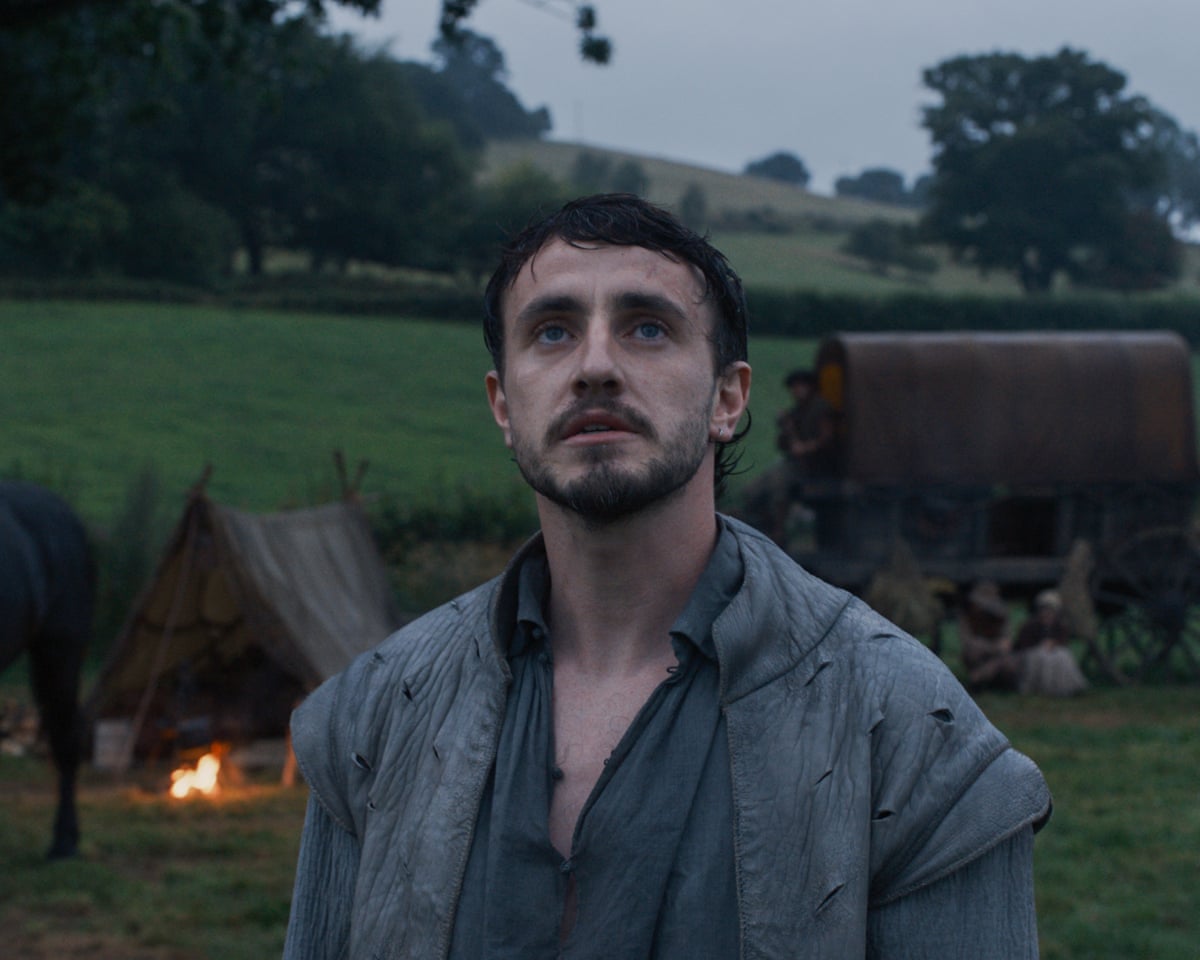
On paper, Hamnet might seem like a conventional film about a visionary man whose genius established him as one of literature’s greatest figures. William Shakespeare is portrayed by an actor known for his magnetic presence across demographics. Yet, the film notably sidelines both Shakespeare and the actor in favor of focusing on Shakespeare’s wife, Anne Hathaway, a woman historically dismissed as unremarkable and abandoned by Shakespeare when he left Stratford-upon-Avon for London.
Anne is referred to as Agnes in the film, a name she was also known by, and is portrayed by Jessie Buckley, an Irish actor renowned for her ability to imbue any role with profound emotion. The film opens with Agnes asleep among the roots of an ancient tree. Though illiterate, she is a skilled herbalist who crafts medicines from plants and keeps a falcon. Agnes is depicted as a strong, intelligent woman, more than a match for the man she calls “the Latin tutor.” Shakespeare’s mother warns him that his bride-to-be is a forest witch.
Historical Context and Creative License
The film is adapted from a novel by Maggie O’Farrell, which imagines a narrative beyond the limited historical facts. Historically, Shakespeare married Anne Hathaway in 1582 when he was 18 and she was 26, in a shotgun wedding prompted by her pregnancy. In 1596, their 11-year-old son Hamnet, a twin, died, likely from the plague. Shakespeare later wrote Hamlet, with its tragic hero’s name echoing that of his deceased son. O’Farrell co-wrote the screenplay with director Chloé Zhao, resulting in a film shaped by strong female perspectives.

Reception and Interpretations
Some viewers have expressed frustration with the film’s departure from strict historical accuracy, questioning whether Anne/Agnes was truly a feminist falconer. While this portrayal is likely fictional, it challenges the misogynistic stereotype of Anne as a dull-witted woman who trapped Shakespeare into marriage. Jessie Buckley is widely regarded as a frontrunner for the Best Actress Oscar, particularly for her raw and powerful expression of grief following her son’s death, a moment that stands out as extraordinary.
"By forefronting Jessie Buckley’s Agnes at the expense of her megastar husband, this female-directed feminist fest gives voice to the anguished howls of disenfranchised women everywhere"
Despite Buckley’s acclaimed performance, Hamnet’s Oscar campaign has encountered some criticism, with detractors labeling it as emotionally manipulative grief porn—a film that compels audiences to cry on demand. While the reviewer admits to being easily moved by films, they did not shed a tear during Hamnet. Instead, the film evoked memories of a GCSE history lesson about a cholera outbreak in Victorian London, where the teacher claimed that women did not grieve their children deeply due to high child mortality rates—a notion the reviewer found deeply unsettling even at age 15.
Exploring the Inner Lives of Women
Hamnet succeeds in revealing the inner lives of women like Anne and Agnes, with Buckley’s portrayal shining as a vivid depiction of emotional depth. The supporting cast also delivers strong performances: Emily Watson brings nuance and feeling to Shakespeare’s stern mother, while Joe Alwyn’s portrayal of Agnes’s brother offers a rare 16th-century male ally who accepts Agnes’s out-of-wedlock pregnancy without judgment. Even the portrayal of Shakespeare himself is commendable.


