Obama’s Impeccable Introduction
It is always an emotional experience to see former US president Barack Obama appear on screen. The Instagram algorithm frequently presents me with clips of him, knowing I am drawn to his charm with babies, statesmanlike speeches, coolness at rallies, articulate wit, composure, compassion, intelligence, handsomeness, and thoughtfulness – in short, a fully functioning adult human. Yet, the algorithm does not realize that I wince in pain before clicking and quietly weep at how far the US has declined, a decline the UK has also seemingly caught up with.
Obama appears at the start of Life, Larry and the Pursuit of Unhappiness: an Almost History of America (a production from his and Michelle Obama’s Higher Ground Productions) to remind us of his flawless comic timing. Walking through what appears to be the new Barack Obama Presidential Center, he modulates his performance so beautifully that I nearly wept again. Had I known the disarray that would follow this masterclass, I would have sobbed.
The Series Overview
Life, Larry and the Pursuit of Unhappiness consists of seven half-hour episodes searching for a punchline.
E pluribus unum.The better episodes manage two or three punchlines; the rest are less fortunate. Each episode contains three or four sketches featuring Larry David from Curb Your Enthusiasm performing his familiar shtick from the show. However, this is a somewhat different and notably inferior experience. It mostly involves shouting lines you have likely heard before, often delivered in period costume.
Historical Sketches and Familiar Themes
In the opening episode, Larry shouts in a powdered wig as a member of the Continental Congress who attempted drafting the Declaration of Independence before Jefferson. In this 18th-century portrayal, Larry’s version intended to address far more than the 27 historical grievances. He advocates making it illegal to share umbrellas (
“You forgot your own umbrella? Too bad!”), sharing desserts (citing Seinfeldian double-dipping reasons), or wishing anyone a happy new year after January 7. He also insists everyone should have the right to ask who other guests are before accepting a dinner party invitation.
It goes on. All the sketches do.
The next sketch concerns the first telephone call between Alexander Graham Bell and his assistant Watson. Both characters are awkward, tedious, and uncertain how to conclude the call. Another sketch, in the third episode, about the McCarthy hearings, extends almost as long as the actual witch hunts themselves.

Other sketches depict Larry shouting as a First World War soldier in the trenches, initially trying to avoid agreeing to deliver a fellow soldier’s letter to his girlfriend if he dies, then attempting to avoid the war altogether by pretending to be shot in No Man’s Land. Another features Larry as the third Wright brother, objecting to having to take the middle seat on their first aircraft. Again, these scenarios feel familiar. 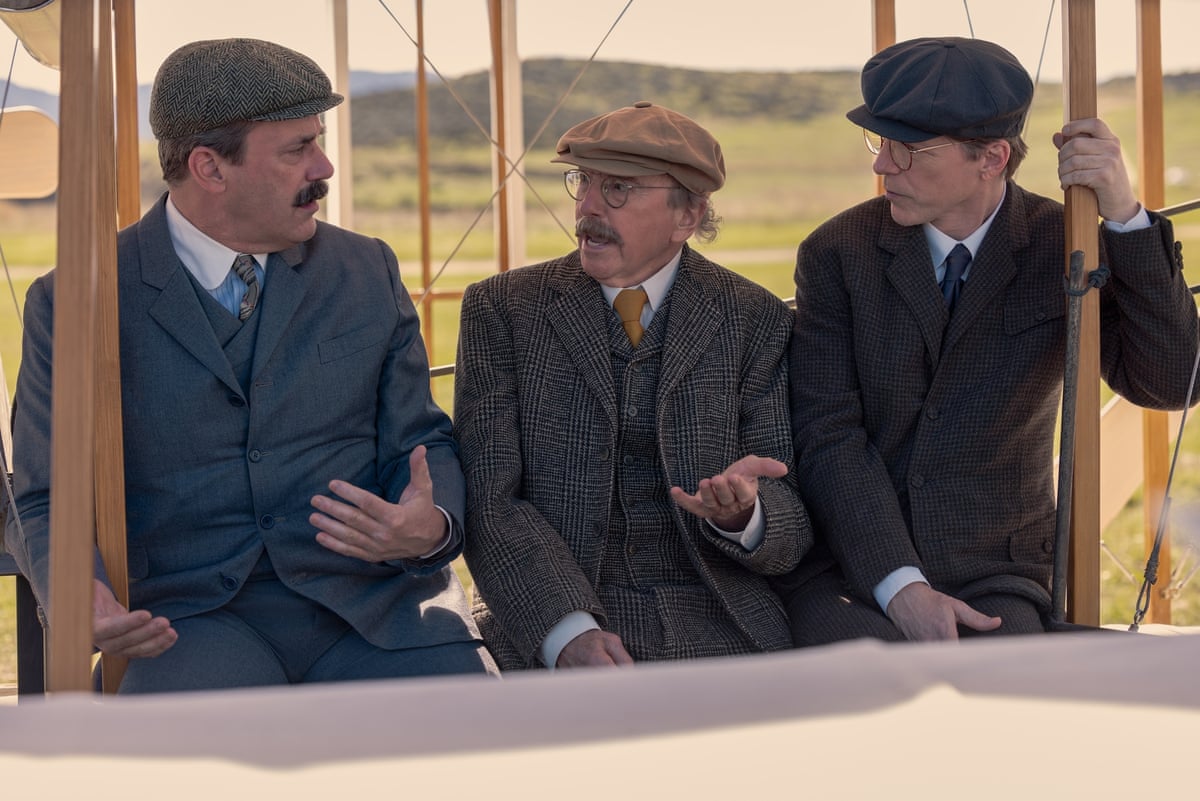
Comedy and Social Commentary
Such familiarity might not be problematic if Larry David’s talents were fully on display, skewering cowardice and hypocrisy so that viewers writhe in exquisite agony alongside him and those around him. Unfortunately, this is not the case.
A couple of sketches touch on racism: Larry as a talkative dullard sitting next to Rosa Parks on a bus, boring her to the back; and Larry as a host on the Underground Railroad, taken advantage of by guests who refuse to help, dismissing it as “slave stuff.” These sketches are both punch-pulling and punching down, resulting in a poor comedic and ethical experience. However, there is one moment – when Larry the Bore asks Rosa if she would rather be robbed by a black or a white man (
“Interesting, sociologically”) – that recalls David at his razor-sharp best, distilling complex human complications into a single line. Such moments, however, are regrettably rare.
Overall Impression
The most striking flaw is the familiarity of the material. The content evokes HL Mencken’s definition of a hotdog as
“the sweepings of the abattoir”rather than peak Larry David, especially during a sketch about Lewis and Clark featuring guest star Jerry Seinfeld, where they embark on their expedition simply to get away from their wives, eliciting forced laughter.
To a degree that Larry David himself would likely disapprove of, Life, Larry and the Pursuit of Unhappiness depends on a blend of faith and nostalgia that borders on charity for any success.
Nonetheless, it is worth watching the Obama introduction and quietly weeping.