

Isaac Julien’s Cosmic House: A Postmodern Meditation on Connection
Cosmic House, London – Isaac Julien, the video artist renowned for his films infused with Black queer desire, presents a kitsch, bombastic, and strikingly elaborate meditation on human connection.
If you appreciate grand designs, Cosmic House is a must-see. Beginning in 1978, postmodernist theorist Charles Jencks and garden designer Maggie Keswick transformed their family home into a cosmic vision scaled to a Victorian townhouse. A "solar stair" with 52 steps spirals from a "black hole" at its base through four floors, each with distinct symbolic themes. The kitchen incorporates classical Indian architectural elements as a playful nod to late summer. In the basement, dedicated to sun worship, Julien’s 25-minute film is screened. The film is equally excessive, unapologetically intellectual, thoroughly kitsch, and, if approached with openness, quite magnificent.
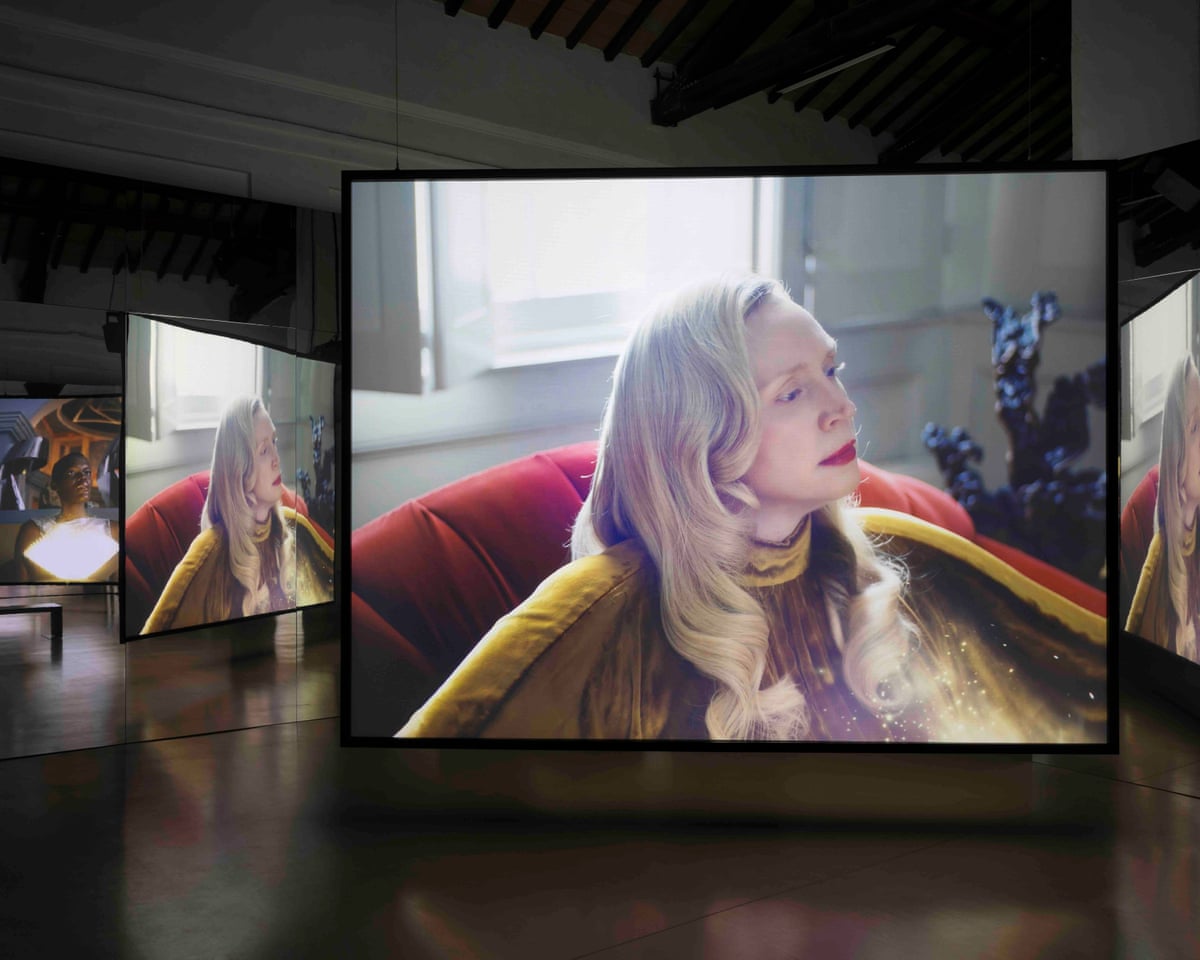
Displayed on a single screen surrounded by a kaleidoscope of standing mirrors, the film stars Sheila Atim and Gwendoline Christie as science-fiction deities. They wander through a Renaissance palazzo, a modernist glass home, and the Cosmic House itself, engaging in a conversation about the end of the world, the possibility of time travel, and the nature of God. Their journey includes enigmatic encounters with cyborg starfish and the conjuring of gleaming spaceships. Firestorms erupt across the sun’s surface, while bioluminescent sea creatures wave neon tentacles. This is not a work for those averse to pretension.
However, for viewers willing to engage, the film offers a compelling experience. Its script is a collage of excerpts from various texts, most notably Octavia E. Butler’s Parable of the Sower. This novel, set between 2024 and 2027 in a dystopian United States, has inspired many artists recently. The story is narrated by Lauren, a pastor’s daughter who derives strength from her unique faith: her logic holds that since everything changes and God is everything, God must be change itself. Julien’s film visually interprets this principle as a poetic expression of constant flux.

The concept of universal connection is simultaneously esoteric and self-evident. For example, the idea that after death one’s body nourishes worms, which feed birds that sing by the grave, is both a simple truth and a poetic image. Julien’s film navigates this delicate boundary between cliché and revelation, incorporating references from Ovid to ecofeminist philosophy. The film’s resonance is enhanced by its setting. Previously shown in an immersive five-screen installation at Victoria Miro gallery, the work appeared aggressively bombastic. In the more intimate and intellectually eclectic environment of Cosmic House, it is easier to appreciate.
Indeed, the film’s message can be seen as quietly revolutionary. In an era obsessed with categorizing individuals and identity politics, its assertion that no identity is fixed carries practical significance. Recognizing our interconnectedness with all that surrounds us might encourage more thoughtful stewardship of the environment. Julien’s goddesses transform into various forms—from playful horses to hovering drones—transcending boundaries between humans, other species, and forms of intelligence.
It may seem surprising that Julien, known for films centered on queer Black desire, would create a work that appears to challenge fixed identities. Yet, the solidarity the film advocates embraces difference rather than denying it, promoting diversity supported by imaginative empathy. As Lauren states about the group she forms to survive the apocalypse:
"it was from the differences between us, not the affinities and likenesses, that love came"
This love prevents internal conflict among groups, which otherwise might weaken them against external threats or tyranny. Like all effective science fiction, Julien’s film speaks to contemporary realities.
The urgency of finding common ground is echoed by philosopher Donna Haraway, who appears at the film’s outset. Like Butler, Haraway argues that survival amid current crises requires rejecting isolationist tendencies and embracing change and new relationships. The film’s core lesson is clear:
"we can’t turn back the clock, things will never be the same and we are all in this together."


