Introduction
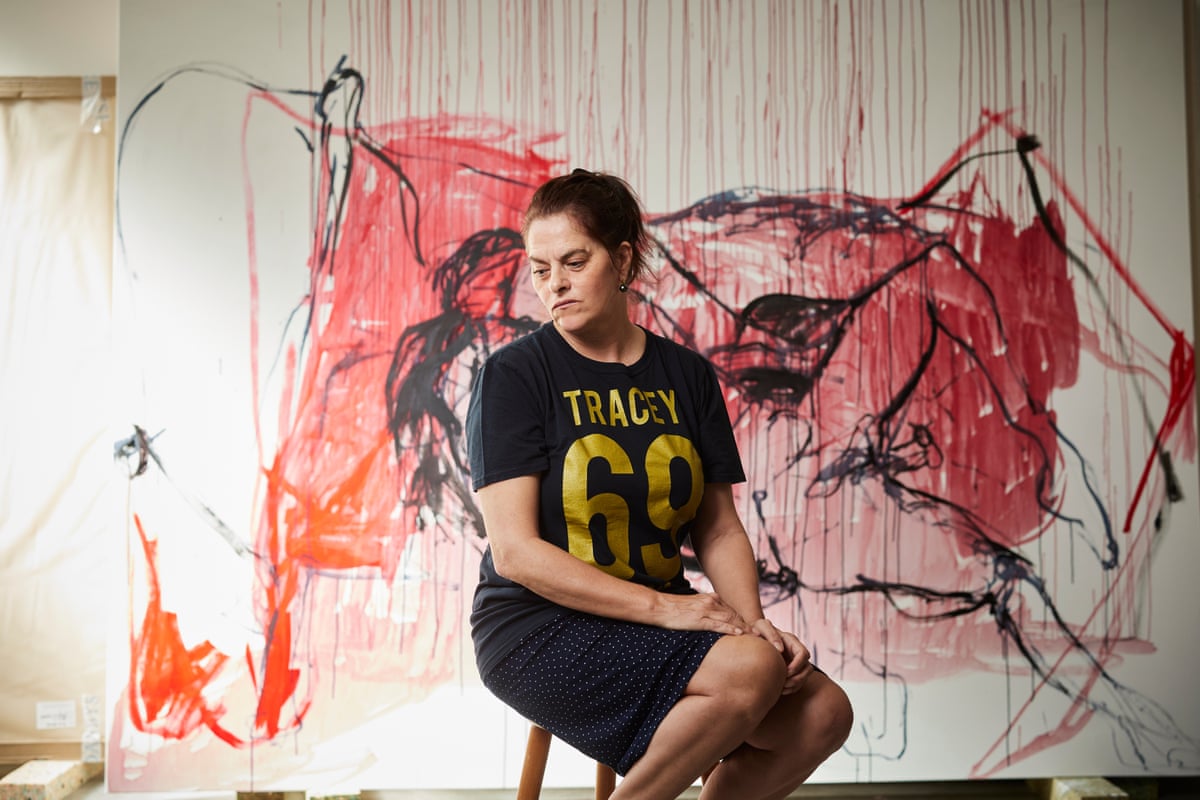
In a photographic self-portrait taken shortly after her 2020 diagnosis of squamous cell bladder cancer, Tracey Emin’s iPhone obscures her right breast as the viewer’s gaze moves down from her catheter to her urostomy bag and disposable underwear. Her body appears fragile in the hospital mirror, yet her gaze is direct and unwavering. It confronts us with a clear message: I matter, this matters — a confident assertion that challenges the typical perception of vulnerability during illness.
Even six years after her life-saving surgery, Emin resists conforming to societal expectations of how her post-operative body should be perceived. Alongside losing her bladder, Emin also underwent removal of her uterus, ovaries, lymph nodes, part of her colon, her urethra, and part of her vagina. Despite these profound changes, she has embraced a striking autonomy in documenting her body’s transformation.
“This is mine, I own it,”she declared not long after her surgery.
These words became a mantra for me during my own hospital recovery. Inspired by Emin, I took self-portraits of my body while recuperating at home. In one image, taken two weeks post-surgery, my right hand lifts my jumper to reveal a swollen and bruised abdomen beneath, with my underwear folded down to expose bloody surgical wounds. Another photograph focuses on the purplish-grey bruise from an IV drip streaking across my left wrist.
Would I have taken these photographs without Emin’s influence? Probably not. In the weeks leading to my own life-saving surgery, I became increasingly absorbed by Emin’s candid Polaroids and autobiographical blankets, which compel viewers to confront aspects of her experience that may be uncomfortable to acknowledge. Nearly three decades after her sculptural work My Bed propelled her to tabloid fame in the late 1990s, Emin continues to challenge audiences to recognize realities they might prefer to avoid. Today, her bleeding nudes focus on the presence of invisible disabilities and what Harry Weller, creative director of Emin’s studio, describes as
“her wild scramble for existence”.
Reflecting on the 1990s, Emin recently told Maria Balshaw, director of the Tate, that people once labeled her work as confessional art.
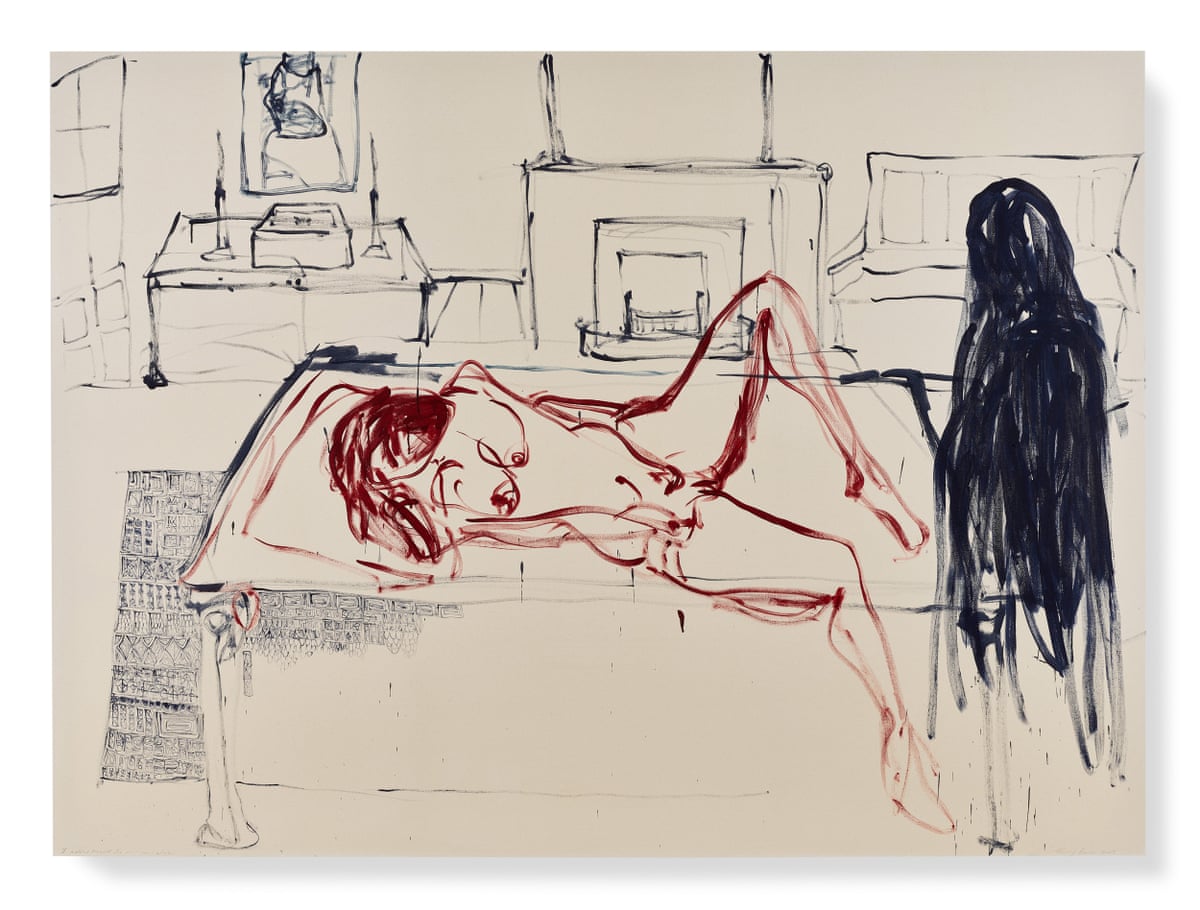
“I wasn’t confessing anything at all to anybody,”she corrected her critics, past and present. I recalled Emin’s vital reframing during a recent visit to her landmark exhibition at Tate Modern, where I contemplated her 2023 painting I watched Myself die and come alive. In this work, her red-stained body lies splayed on a table, watched over by the black cloak of death, with her mother’s ashes resting in a casket behind her bloodied hair. Like much of Emin’s art, this painting does not seek a particular gaze from viewers; it exists independently, which lends it a powerful corporeal presence. The same applies to her 2024 painting Barbed Wire Stitches, where her white thighs part like rugged cliffs to reveal black sutures between them.

Reconsidering 'Confessional' Art
Whether described as visceral or personal, I, like Emin, find the term “confessional” problematic when applied to women expressing their experiences. The term implies guilt or shame in drawing attention to oneself through life and art, as if an apology is required. Emin has never accepted this notion. Similarly, Frida Kahlo, whose retrospective is set to open at Tate Modern next month, also rejected such falsehoods during her tragically brief life (she died at 47).
Mexico’s prolific artist Kahlo developed her magical realist visions during the months following a 1925 tram accident that severely injured her. A metal rail pierced her abdomen and exited through her vagina, fracturing her spinal column, collarbone, and pelvis, and causing irreversible damage to her reproductive organs. During her recovery, her parents affixed a mirror to the canopy of her bed so she could see herself and, through her palette, be seen. This act of emancipation is evident in her 1932 painting My Birth, a surreal depiction of her birth and miscarriage intertwined. The painting portrays childbirth as a Kafkaesque scene, with the mother’s head covered and the baby’s lifeless body positioned between splayed limbs and bloodstains. Though gruesome, like Emin’s selfie nearly 90 years later, it is an unvarnished reality. How we engage with these works reveals much about our willingness to acknowledge bodily realities and on what terms.
As Kahlo’s biographer Hayden Herrera noted in 1983, Kahlo’s art possesses an intensity and strength
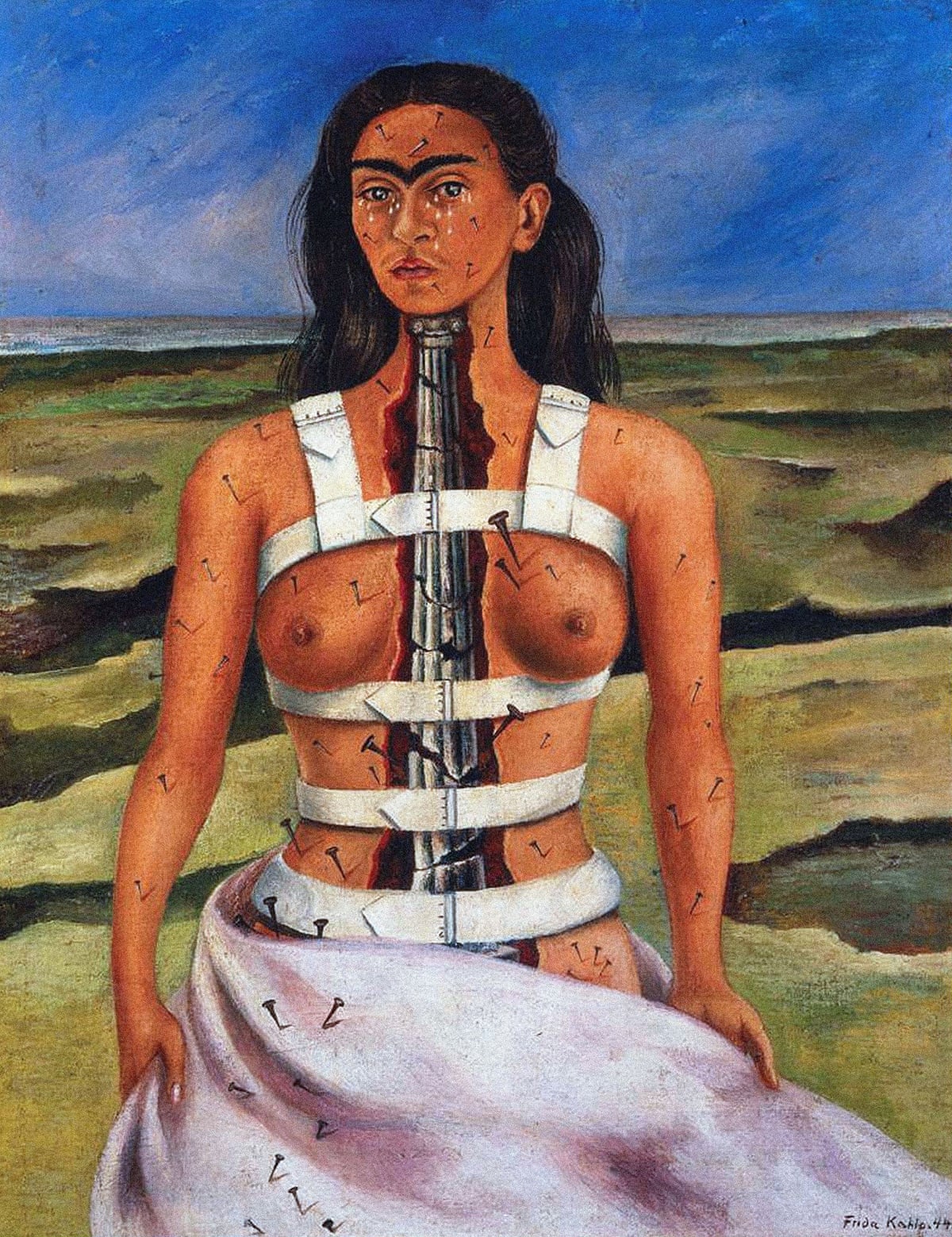
“that can hold the viewer in an uncomfortably tight grip”.This is evident in her 1944 painting The Broken Column, a courageous self-portrait of chronic pain that evokes Christian Saint Sebastian iconography. Kahlo’s martyrdom is depicted through her nail-pierced torso, which, like the cracked desert landscape behind her, is split open to reveal blood-red flesh. A fractured classical column supports her chin, rendering her as rigid as stone.
Transforming Pain into Art
With an anatomical focus on her wounds, Kahlo redrew what she called her body’s landscape on her own terms, transforming her disabilities into something transcendental. This devotional act enabled her to elevate the mundane experience of chronic pain into something extraordinary. I believe the same can be said of Emin.
Questions such as
“What would she have done if she had had any children?”and
“Also, what if she hadn’t had one misfortune after another?”continue to haunt Emin’s work as they did Kahlo’s. For both artists, their intensely personal experiences — including illness, disability, miscarriage, and abortion — have always been central to their canvases. These experiences have drawn me closer to their work as I navigate my own health challenges, including multiple surgeries and the prospect of more to come.
Two decades after my thyroid cancer diagnosis and three years following a bowel cancer scare, I return repeatedly to these artists to cultivate a sense of autonomy and deepen my understanding of carrying both light and darkness within my bodily narrative. I see defiance and vitality in Emin’s bleeding stoma selfies. I see the pink flesh of the melon in Kahlo’s 1953 painting Fruta de la Vida, evoking the crimson innards of the artist’s wounds. Through their art, I witness how pain can be transformed into meaning — a way to comprehend the body when it turns against itself.